Whale Watch Screensaver
The Whale Watch screensaver plots recent, scientifically verified whale and dolphin sightings on a world map, pulsing in live and key-less from GBIF, the global open biodiversity data network. It's free, runs in your browser, and ESC exits.
Live preview
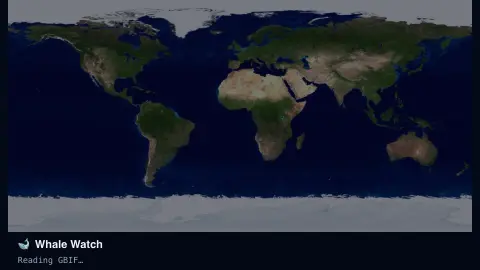
Press ESC to leave fullscreen. Settings are saved in your browser only.
How the Whale Watch screensaver works
The saver queries GBIF's occurrence API for the most recent verified cetacean records worldwide, with no key required.
Each sighting pulses onto a world map at its recorded coordinates, colored by species, then fades as newer ones arrive.
A running tally counts sightings by species since you started watching.
Pick humpback, blue whale or orca, or leave it on all cetaceans for the full mix.
How whale sightings reach a biodiversity database
GBIF, the Global Biodiversity Information Facility, is an international, non-commercial organisation that makes biodiversity data available online. Many institutions around the world supply its records, and citizen scientists have contributed to its growth. Each occurrence record is tied to a taxon, a place and a date, and carries a basis of record that says how it was made, with categories such as human observation, preserved specimen and material sample.
Whales belong to the order Cetacea, which also includes dolphins and porpoises. Because records depend on where people are looking and reporting, sightings cluster in well-watched places, and a bare patch on the map may reflect few observers rather than few whales.
Records also arrive some time after the event, since data have to be submitted by their publishers and then ingested, and the date shown is the observation date. Many whale species travel seasonally between feeding and breeding areas, so a map of sightings changes over the year. This is a sample of reported observations. It is not a count of whales or a tracker for any single animal.
A worked example
Set it to Humpback whale during their migration season and dots cluster off Hawaii, Australia and Alaska — the real known breeding and feeding grounds.
Settings & tips
- Species narrows the map to one cetacean.
- Accent recolours the pulse dots.
- Fewer dots for deep-diving species is real reporting frequency, not a broken feed.
Frequently asked questions
- Are these live tag pings?
- No — GBIF aggregates verified sighting and stranding records from researchers and whale-watch operators, refreshed continuously but not a live GPS tag feed.
- Is a key needed?
- No. GBIF's public API is free and key-less.
- Why do sightings cluster seasonally?
- Real migration timing — whales concentrate in feeding and breeding grounds at predictable times of year.
- Is it free?
- Yes — free, no download, in your browser.
- Do whales really migrate on a schedule?
- Many baleen whales feed in cold, productive waters and travel to warmer waters to breed. Timing varies by species and population, so patterns are broad rather than exact.
- What does basis of record mean?
- It is a field on each GBIF record describing what kind of evidence it is, such as a human observation, a preserved specimen or a material sample.
- Are all cetaceans whales?
- Whales, dolphins and porpoises are all cetaceans, and the common names overlap. Orcas, for example, belong to the dolphin family.