Aquarium Screensaver
Aquarium is a free, in-browser screensaver of a calm fish tank: fish glide across sunlit water in depth layers while bubbles rise and strands of kelp sway. It's a quiet, always-on scene with nothing to download. Open the page to fill the screen with water, and press ESC to exit.
Live preview
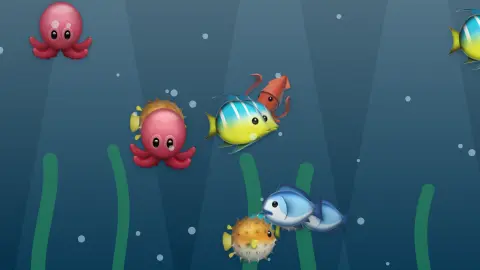
Press ESC to leave fullscreen. Settings are saved in your browser only.
How the Aquarium screensaver works
Each fish is given a random depth between near and far. That depth sets its size, swim speed, and opacity, so closer fish are bigger, faster, and solid while distant ones are smaller and fade into the water — a parallax effect that gives the tank a sense of layers. The fish are drawn back-to-front so near ones overlap the far ones.
The fish themselves are full-color emoji glyphs (tropical fish, sharks, dolphins, even an octopus). Each one swims horizontally, gently bobs up and down on a sine wave, and tilts with a subtle wobble; when it reaches the edge it turns around and the glyph is flipped to face the new direction. Fish sets how many share the tank and Speed scales their pace.
The water is a vertical gradient in your chosen Water color, lighter at the top, with three faint angled light shafts drifting slowly to suggest sun through the surface. When Kelp is on, several strands rise from the bottom and ripple side to side on a sine wave.
When Bubbles is on, a couple dozen small bubbles rise from the depths, swaying as they go, and respawn at the bottom once they reach the surface — a constant gentle shimmer over the whole scene.
The tank as a screen
The word aquarium is credited to the English naturalist Philip Henry Gosse, who used it as the title of his 1854 book The Aquarium: An Unveiling of the Wonders of the Deep Water. It combines the Latin aqua, water, with the suffix -arium, and it came to name glass tanks holding living water creatures. Keeping fish at home has been a pastime ever since, and on computers the fish tank has long been a favourite for idle screens.
The fish here are emoji, text characters drawn by the operating system's own font. That means their look depends on your device: Apple, Google, Microsoft and Samsung each draw them in their own style, so the same tank can look quite different on a phone and a laptop. A shark or dolphin you see is a character that your system provides, not an image from this site.
A real tank is a balanced ecosystem, with bacteria breaking down fish waste in a process called the nitrogen cycle. A screen tank needs no feeding, no filter and no cleaning, although it also cannot offer the real thing.
A worked example
With the defaults — Fish 12, Bubbles on, Kelp on, the deep-blue Water color, Speed 4 — a dozen fish of varying sizes cruise across the tank, the bigger close ones passing in front of smaller hazy ones, while bubbles drift upward and kelp sways at the bottom under slow light shafts. Push Fish to 30 for a crowded reef, or drop Speed to 1 for an extra-lazy, calming tank.
Settings & tips
- Raise the Fish count for a busy reef or lower it for a sparse, meditative tank with just a few swimmers.
- Change the Water color to set the mood — deep blue for open ocean, a greener tone for a planted freshwater look.
- Turn off Bubbles or Kelp if you want a cleaner, more minimal scene, or lower Speed for a slower, calmer drift.
Frequently asked questions
- Is the Aquarium screensaver free?
- Yes. It runs free in your browser with nothing to download or install. Open the page and the tank fills with fish.
- How do I exit the aquarium screensaver?
- Press the ESC key to close it. Moving the mouse or clicking also returns you to the page.
- Can I add more fish?
- Yes. The Fish slider sets how many fish are in the tank, from a single swimmer up to a crowded reef of thirty.
- Why do some fish look bigger and clearer than others?
- Fish are placed at different depths. Closer fish are drawn larger, faster, and more solid, while distant ones are smaller and faded, creating a parallax sense of depth.
- Can I turn off the bubbles or kelp?
- Yes. Bubbles and kelp each have their own toggle, so you can switch either off for a cleaner, more minimal tank.
- Why do the fish look different on my Mac and my PC?
- They are emoji characters drawn from your system's font, and each vendor designs its own artwork.
- Who coined the word aquarium?
- The English naturalist Philip Henry Gosse, whose 1854 book The Aquarium popularised the term for a tank holding live water life.
- Does a real aquarium need a filter?
- Most do. Bacteria in the filter convert toxic fish waste into less harmful compounds, a process called the nitrogen cycle.