Lava Lamp Screensaver
The Lava Lamp screensaver is a free, in-browser animation of glowing blobs that slowly drift, merge and split like molten wax. It uses a metaball technique, where overlapping circular fields blend into a single gooey shape. There is nothing to download or install, and you press ESC at any time to exit.
Live preview
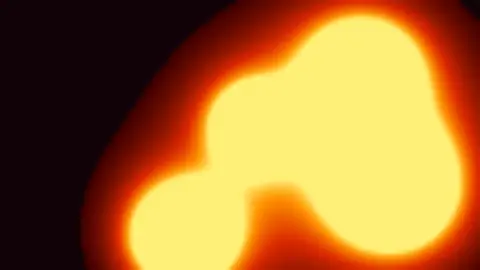
Press ESC to leave fullscreen. Settings are saved in your browser only.
How the Lava Lamp screensaver works
Each blob is a moving circle with a position and a constant velocity. On every frame the blobs nudge along their direction and bounce off the edges of the frame, so they wander the screen forever without ever leaving it.
The gooey look comes from a metaball field. For every pixel the code sums an influence from each blob equal to its radius squared divided by the squared distance to that blob, so nearby blobs contribute strongly and distant ones barely at all. Where the combined field crosses a threshold of 1, the pixel is painted; otherwise it stays the background color.
Inside the lit region the field value is mapped through a four-stop color gradient, so the densest cores glow brightest while the thin edges fade toward the background. That is why two blobs appear to stretch and fuse into one mass as they approach, then snap apart as they separate.
For speed, the whole field is computed on a small offscreen buffer and then scaled up to fill the screen. Turning on Soft glow enables image smoothing during that upscale, which softens the blobs into a true liquid blur.
What happens inside a real lava lamp
The lava lamp was invented in 1963 by Edward Craven Walker, a British entrepreneur who founded the lighting company Mathmos. It is a small demonstration of convection. A bulb heats a wax mixture at the base. The wax expands, becomes less dense than the surrounding liquid, and rises as a blob. At the top it cools, grows denser again and sinks, where the cycle repeats.
Heat also makes the wax more fluid, and a metal wire coil in the base breaks the surface tension of the cooled blobs, letting them merge and start rising again. The underlying physics is a form of Rayleigh-Taylor instability, in which a denser fluid and a lighter one trade places. A cold lamp does nothing until the wax has warmed enough to become buoyant.
The digital version trades physics for geometry. The merging and splitting of blobs is a classic computer graphics effect, as the shapes bulge toward each other and fuse without ever being drawn explicitly, which loosely echoes how real wax blobs join.
A worked example
With the defaults — Blobs 6, Flow speed 4 and the Lava palette — six metaballs roam a low-resolution field. Flow speed 4 scales the per-frame drift, so the blobs glide unhurriedly. The Lava gradient runs from dark red cores through orange to a pale yellow rim, and with Soft glow on the upscale blurs every edge into that classic molten wax look.
Settings & tips
- Lower Flow speed toward 1 for a hypnotic, almost-still ooze, or push it to 10 for restless, fast-merging blobs.
- Switch the Palette from Lava to Ocean, Toxic or Mono to recolor the gradient without changing the motion.
- Add more Blobs (up to 12) for a busier, more interconnected field, or drop to 3 for clean, isolated globs.
Frequently asked questions
- Is the lava lamp screensaver free?
- Yes. The Lava Lamp screensaver is completely free and runs in your web browser with nothing to download or install.
- How do I exit the lava lamp screensaver?
- Press the ESC key to exit at any time. Moving the mouse or pressing any key also returns you to the page.
- What are the blobs made of?
- They are metaballs, a graphics technique where overlapping circular fields blend into one smooth shape. This is what makes the blobs merge and split so smoothly.
- Can I change the lava lamp colors?
- Yes. The Palette control offers Lava, Ocean, Toxic and Mono, and you can set your own background color underneath the glow.
- Does the lava lamp screensaver need a download?
- No. It runs entirely in the browser, so there is no app, plugin or installer required on Windows, Mac or Linux.
- Why does a real lava lamp take so long to start?
- The wax must warm until it expands and becomes less dense than the liquid, which takes time with a small bulb. Until then it stays in a lump at the bottom.
- Are lava lamps used for anything serious?
- Yes. Cloudflare keeps a wall of lava lamps in the lobby of its San Francisco office, filmed by a camera, as an extra source of entropy for its random number generation, alongside other sources.
- Why do blobs merge instead of bumping?
- In a real lamp a wire coil in the base breaks the surface tension of cooled blobs so they can merge. The digital blobs fuse because their overlapping fields are added smoothly.