Plasma Screensaver
Plasma is a free, in-browser screensaver that recreates the classic demoscene effect: overlapping sine waves blend into a slow, shifting field of color. It is generated live from math, not a looping video. Nothing to download, and ESC exits whenever you like.
Live preview
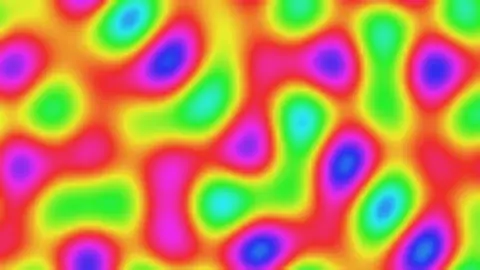
Press ESC to leave fullscreen. Settings are saved in your browser only.
How the Plasma screensaver works
For every pixel the code adds together four sine waves: one along x, one along y, one along the diagonal x+y, and one based on the distance from the center. Summing these interfering waves gives each pixel a smoothly varying value, the heart of the plasma look.
That summed value is normalized into the 0–255 range and used as an index into a precomputed 256-entry color lookup table. The Rainbow palette walks the full hue circle, while Fire, Ocean and Mono are built from gradient stops, so the same math can wear very different skins.
Animation comes from a time term added inside every sine, which slides the wave phases each frame. In Rainbow mode the palette index is additionally scrolled over time, so colors cycle through the spectrum as the shapes morph.
Like the other field effects here, plasma is rendered on a small offscreen canvas and scaled up to the screen. The Smooth toggle enables bilinear upscaling, blending the low-resolution buffer into soft, continuous gradients instead of blocky pixels.
A classic of the demoscene
The plasma effect is a real-time computer visual in which colours cycle and warp to suggest fluid, organic movement. It became a staple of the demoscene, the hobbyist community that wrote tiny graphics programs to show off what a computer could do, especially in the early 1990s, and it was often a beginner’s first demo effect on PC. Colours are typically generated from mathematical formulas such as sums of sine waves, with sine tables and palettes used to keep it fast.
The original VGA plasma demo, created by Bret Mulvey in 1988, used the 256-colour mode and cycled the hardware palette. Rotating a palette makes colours appear to flow without touching the pixels at all, which was very cheap on hardware of the time.
Despite the name, it has nothing to do with the physical state of matter. What you see is interference: sine waves of different directions add where they agree and cancel where they do not, producing blobs and ridges that shift as the phase slides. A cyclic palette helps the flow, because every shade eventually returns to its starting colour, so there is no seam when the phase wraps.
A worked example
With the defaults — Rainbow palette, Scale 5, Speed 4, Smooth on — the four sine waves are sampled at a medium frequency (Scale sets how tight the bands are), and the whole field drifts at a relaxed pace. Because Rainbow is active, the lookup table also scrolls, so the bands continuously shift hue. Smoothing upscales the small buffer into the silky color blends demosceners made famous.
Settings & tips
- Lower Scale for big, lazy color blobs, or raise it toward 10 for tight, intricate interference patterns.
- Switch the Palette to Fire, Ocean or Mono to completely change the mood while keeping the same motion.
- Turn off Smooth for a deliberately retro, pixelated low-res look straight out of a 90s demo.
Frequently asked questions
- What is the plasma effect?
- Plasma is a classic demoscene visual where interfering sine waves create smoothly shifting fields of color. It was popular on home computers in the late 1980s and 1990s.
- Is the plasma screensaver free?
- Yes. It runs free in your browser with no download, install or sign-up required.
- How is the plasma generated?
- Each pixel sums four sine waves and the result is mapped through a color palette. A time term shifts the waves so the pattern animates.
- How do I exit the plasma screensaver?
- Press the ESC key at any time to exit and return to the page.
- Can I change the plasma colors?
- Yes. The Palette control offers Rainbow, Fire, Ocean and Mono, each driving a different color lookup table over the same animation.
- Is this a real plasma?
- No. The effect is a sum of sine waves mapped to colours, with no simulation of ionised gas.
- Why does the animation loop without a seam?
- Sines are periodic, so after one period they return to the same value, and a cyclic palette returns to its start colour. Together they make the motion repeat smoothly.
- What is the demoscene?
- It is a computer-art subculture that makes real-time audiovisual demonstrations. Plasma was a common early demo effect.