Kaleidoscope Screensaver
The Kaleidoscope screensaver is a free, in-browser animation that mirrors drifting points of light through a ring of reflected segments into a slowly turning mandala. Like a real kaleidoscope, a small set of moving shapes is repeated and flipped around the center so symmetry appears from simple motion. It runs instantly with no download. Press ESC to exit.
Live preview
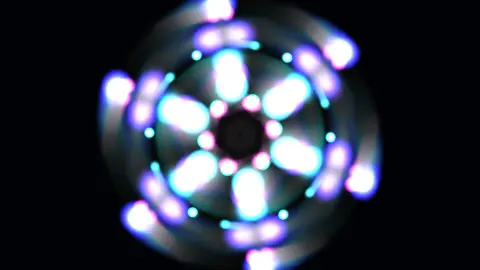
Press ESC to leave fullscreen. Settings are saved in your browser only.
How the Kaleidoscope screensaver works
A handful of glowing points — the Particles count (4 to 16) — drift around the center of the screen. Each point has a radius, an angle, a size and a hue, plus small random rates of change for each, so it slowly spirals outward or inward and shifts color over time. These few points are the only real shapes; everything else on screen is a reflection of them.
The mirror effect comes from drawing that same set of points many times. The circle is divided into wedges set by the Mirror segments count (3 to 12), and the canvas is rotated to each wedge in turn. Within each wedge the saver draws the points twice — once normally and once flipped vertically — which is the reflection that turns a drifting point into a symmetric mandala.
Each point is rendered as a soft radial gradient that fades from a bright hue at its core to transparent at its edge, and all of it is drawn in 'lighter' blend mode so overlapping reflections add up into glowing highlights. The whole arrangement is also slowly rotated over time, set by the Speed control, so the mandala turns as it shifts.
Instead of clearing the screen each frame, the saver paints a faint translucent layer of the Background color over the previous frame. That leaves gentle motion trails behind the moving points, giving the kaleidoscope its smooth, flowing, ever-shifting feel rather than a hard redraw.
Brewster's tube and the geometry of mirrors
The kaleidoscope was invented by the Scottish scientist Sir David Brewster, who was granted a British patent (no. 4136) in July 1817 and coined the name. The patent describes a most common form with two reflectors, set at an angle, with objects at one end that appear as a symmetrical pattern from the other. The name comes from the Greek words kalos (beautiful), eidos (form) and skopeo (to look).
The symmetry belongs to a family in mathematics called dihedral symmetry: rotations through equal angles combined with mirror reflections. In the patent Brewster found angles of 18°, 20° or 22½° the most pleasing; his 1819 treatise gave 45°, 36° and 30° as primary examples. These divide evenly into a full turn, so the repeated wedges alternate between a picture and its mirror image, which hides the seams. An angle that does not fit evenly would show visible breaks.
A software version replaces physical beads with a few moving shapes and mirrors them. The result is more orderly than it feels, since a small amount of random motion in one wedge is multiplied across the whole disc. That is also why kaleidoscope images can feel intricate without carrying much information, and why changing a single moving point changes the entire screen.
A worked example
With the defaults — Mirror segments: 6, Particles: 9 and Speed: 4 — nine glowing points drift around the center, each slowly changing radius, angle and hue. The canvas is rotated to each of the 6 wedges and the points are drawn twice per wedge (once flipped), so those 9 points become a 6-fold symmetric mandala. Everything rotates gently over time and a faint background wash each frame leaves soft trails, so the pattern continuously turns and reshapes.
Settings & tips
- Raise Mirror segments toward 12 for a tighter, more intricate mandala, or drop it to 3 for bold, simple triangular symmetry.
- Increase Particles for a busier, denser pattern, or lower it for a cleaner kaleidoscope with more breathing room.
- Set a darker Background color to make the glowing trails stand out, and adjust Speed to control how fast the whole mandala turns.
Frequently asked questions
- Is the Kaleidoscope screensaver free?
- Yes. It is free and runs in your browser with no download or sign-up. Open the page and the mandala forms and turns on its own.
- How does a kaleidoscope screensaver work?
- A few drifting points of light are mirrored and repeated around the center through a ring of reflected wedges. That symmetry turns simple motion into a turning, ever-shifting mandala.
- How do I exit the Kaleidoscope screensaver?
- Press the ESC key to exit at any time. Moving the mouse or pressing any key also returns you to the controls.
- Can I change the number of mirror segments?
- Yes. The Mirror segments control sets the symmetry from 3 to 12 wedges, and the Particles and Speed controls change how busy and how fast the mandala is.
- Why does the pattern leave trails?
- Each frame paints a faint translucent layer over the last instead of fully clearing it. That leaves soft motion trails behind the moving points for a smooth, flowing look.
- Who invented the kaleidoscope?
- Sir David Brewster, a Scottish scientist, who was granted a British patent for it in July 1817 and coined its name.
- Why do the segments meet without seams?
- Neighbouring wedges are mirror images of each other, so the pattern is continuous across each mirror line. This only works when the wedge angle divides evenly into a full circle.