Glacier Watch Screensaver
The Glacier Watch screensaver runs a live counter of ice lost from the world's benchmark glaciers, extrapolated from real published annual mass-balance figures — the same anchor-and-extrapolate approach as this site's Population Clock. It's free, runs in your browser, and ESC exits.
Live preview
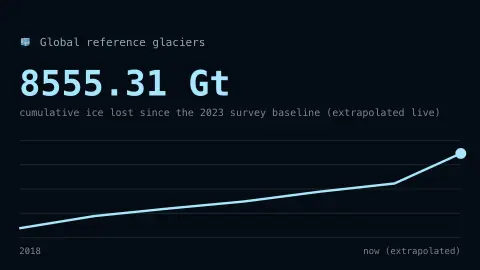
Press ESC to leave fullscreen. Settings are saved in your browser only.
How the Glacier Watch screensaver works
The saver starts from a real, published annual mass-balance figure for the chosen reference glacier or global glacier average.
It extrapolates that real rate into a smoothly ticking loss counter for the time you've been watching.
A small trend chart shows the real multi-year mass-balance history behind the number.
Figures are updated periodically as new annual survey data is published, not fetched live.
Reading a glacier's mass balance
Glaciologists describe a glacier's health with its mass balance: the snow and ice gained over a year, mostly from snowfall, minus what is lost by melting, sublimation and calving. The figure is usually expressed in metres of water equivalent, meaning the thickness of water that the lost or gained ice would make if spread over the glacier. A negative number means the glacier shrank that year.
Long records come from reference glaciers, a globally distributed sample of series that the World Glacier Monitoring Service (WGMS) describes as having more than 30 years of ongoing glaciological mass-balance measurements. Qualifying glaciers must respond mainly to climate rather than to avalanches, calving or surges, and the glaciological method relies on point measurements such as stakes drilled into the ice and snow pits. WGMS also encourages recalibrating these series against geodetic surveys.
A counter that ticks smoothly is an illustration of an annual rate. Real melt is strongly seasonal and varies from year to year with snowfall and temperature, so the true loss does not arrive at a steady pace. Mass balance is also a different quantity from the change in a glacier's length, which responds more slowly.
A worked example
Set it to Global reference glaciers and watch the counter tick upward in tonnes of ice lost — extrapolated from the real published annual average, the same honest-estimate approach as the Population Clock.
Settings & tips
- Reference glacier switches between global average and named benchmark glaciers.
- Accent recolours the counter and chart.
- Like the Population Clock, this is a real anchor rate extrapolated smoothly, not a live sensor feed.
Frequently asked questions
- Is this a live sensor reading?
- No glacier reports mass balance in real time — this extrapolates a real published annual rate, exactly like the site's Population Clock does for population.
- Where do the figures come from?
- Published benchmark-glacier mass-balance surveys (the same reference glaciers used in climate science).
- How often are the anchor numbers updated?
- Periodically, as new annual survey results are published.
- Is it free?
- Yes — free, no download, in your browser.
- What does metres of water equivalent mean?
- It converts snow and ice of differing density into the equivalent depth of liquid water, so that gains and losses can be compared across glaciers and years.
- What is a reference glacier?
- WGMS uses the term for a glacier with a long, continuous series of ground-based mass-balance measurements, more than 30 years, whose changes are driven mainly by climate.
- Does a negative balance mean a glacier will vanish?
- Not by itself. It means the glacier lost mass that year; whether it persists depends on its size and how many such years follow.