Species Discovery Feed Screensaver
The Species Discovery Feed screensaver scrolls species newly described in scientific literature, drawn key-less from GBIF's taxonomic backbone — real new names entering science. It's free, runs in your browser, and ESC exits.
Live preview
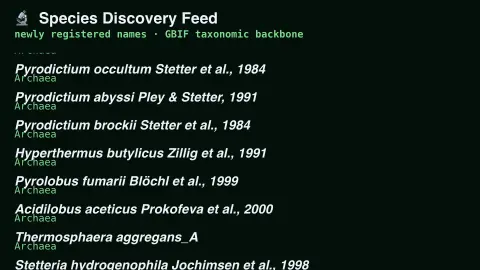
Press ESC to leave fullscreen. Settings are saved in your browser only.
How the Species Discovery Feed screensaver works
The saver queries GBIF's taxonomic backbone for recently registered scientific names, with no key required.
Each new name scrolls through with its scientific name and taxonomic rank.
A running count tracks how many new names have appeared since you started watching.
The feed refreshes on a schedule to track real ongoing taxonomic work.
How a species name enters science
Naming a new species is a formal process. A researcher describes the organism in a published work, gives it a two-part name made of a genus and a species epithet, and designates a type specimen so that later scientists can check what the name refers to. For animals, the International Code of Zoological Nomenclature requires names published after 1999 to fix a holotype or syntypes in the original publication. Plants, fungi and algae follow the separate International Code of Nomenclature for algae, fungi, and plants.
GBIF, the Global Biodiversity Information Facility, is an international network and data infrastructure funded by governments, aimed at open access to biodiversity data. Its taxonomic backbone is a single, synthetic classification meant to cover all the names GBIF deals with, so that name-based records from many sources can be matched to one entry. The feed picks up recently registered names from this backbone, with their rank, which can be species but also genus, family or another level.
A name appearing in the feed does not necessarily mean a creature was found last week. It reflects when the name entered the dataset, and the original publication may be older. Names can later be revised, merged or treated as synonyms as taxonomists reassess the evidence.
A worked example
You might see a newly named beetle or orchid scroll past — a real species just formally entered into the global taxonomic record, not a simulation.
Settings & tips
- Accent recolours the scrolling names.
- Most new species are insects and plants — the real bulk of undescribed biodiversity.
- Taxonomic registration can lag actual discovery by months.
Frequently asked questions
- Are these real new species?
- Yes — they're real scientific names newly registered in GBIF's taxonomic backbone, the same registry researchers use.
- Is a key needed?
- No — GBIF's public API is free and key-less.
- How many species are described each year?
- Real estimates put it around 15,000–20,000 newly described species annually, mostly insects.
- Is it free?
- Yes — free, no download, in your browser.
- What is a type specimen?
- It is the specimen that anchors a species name, usually a preserved specimen kept in a collection. If scientists later disagree about what the name means, they return to the type for comparison.
- Can a newly described species later be renamed?
- Yes. If the same species turns out to have been described earlier, the oldest available name is generally the valid one under the zoological code, and the newer name becomes a synonym.