Coral Bleach Alert Screensaver
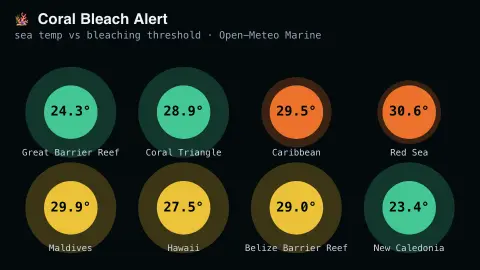
The Coral Bleach Alert screensaver reads live sea-surface temperature at named coral reefs worldwide and compares each to its known bleaching threshold, so current heat-stress risk is visible at a glance — key-less, live from Open-Meteo Marine. It's free, runs in your browser, and ESC exits.
Live preview
Press ESC to leave fullscreen. Settings are saved in your browser only.
How the Coral Bleach Alert screensaver works
The saver fetches live sea-surface temperature at a set of named reefs — the Great Barrier Reef, Coral Triangle, Caribbean and more.
Each reef is compared against its known real bleaching-stress threshold.
Reefs at or above threshold glow warning colors; reefs well below stay a calm blue-green.
The panel refreshes on a schedule so risk tracks real conditions as they change.
Heat stress, bleaching and the thresholds behind this panel
Reef-building corals live in partnership with microscopic algae that give them colour and much of their food. When the water stays too warm, the corals expel the algae, lose their colour and turn white, which is bleaching. Bleached coral is not dead, but if the stress lasts, many colonies die.
NOAA Coral Reef Watch sets a bleaching threshold for each location at its Maximum Monthly Mean (MMM), the highest average summertime sea-surface temperature, plus 1 °C. Its Degree Heating Week (DHW) product is a running total of heat stress over the previous 12 weeks in °C-weeks, adding only days when a HotSpot is 1 °C or more above the MMM. NOAA describes reef-wide bleaching as expected around 4 °C-weeks and mortality of heat-sensitive corals as likely at 8 °C-weeks or more. Because the threshold is local, the same temperature can be harmless at one reef and damaging at another.
Open-Meteo's marine service supplies gridded model data rather than a thermometer reading at the reef. The panel uses a fixed threshold per site, so it is a simple indicator and not NOAA's multi-week DHW calculation. A warning colour here signals heat, not confirmed bleaching.
A worked example
During a marine heatwave the Great Barrier Reef tile might glow amber — sea temperature approaching its bleaching threshold — a real early-warning signal, not a dramatization.
Settings & tips
- Show reef names toggles the text labels.
- Accent recolours the warning glow.
- Thresholds are published bleaching-stress figures, an approximation of the official NOAA product.
Frequently asked questions
- Is this the official NOAA Coral Reef Watch alert?
- No — it's a live approximation using real sea temperature against published bleaching thresholds, not NOAA's official Degree Heating Weeks product.
- Is a key needed?
- No. Open-Meteo Marine is free and key-less.
- Which reefs are included?
- A built-in set of well-known reef systems spanning the Pacific, Atlantic, Caribbean and Indian Ocean.
- Is it free?
- Yes — free, no download, in your browser.
- What are degree heating weeks?
- A NOAA Coral Reef Watch measure of accumulated heat stress: a running total over the previous 12 weeks that only counts temperatures at least 1 °C above a reef's Maximum Monthly Mean. It captures both intensity and duration.
- Why can corals recover from bleaching?
- A bleached coral is still alive, so if temperatures fall soon enough it can regain its algae and colour. Prolonged or repeated stress reduces the chance of recovery.
- Is the temperature measured at the reef?
- No. It comes from gridded marine data for the site's coordinates, so it estimates the surrounding water rather than a local sensor reading.