Sunrise Wave Screensaver
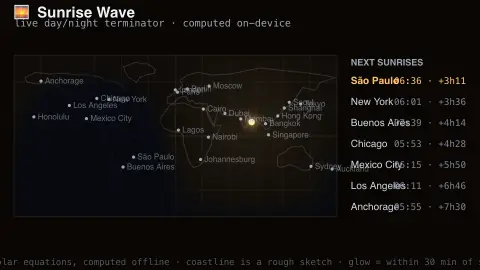
Sunrise Wave draws a world map with the real day/night terminator and twilight bands sweeping across it in real time, computed on your device from the NOAA solar equations. Twenty-six major cities glow as their sunrise approaches, with the next sunrises queued in order. It's free, fully offline, and ESC exits.
Live preview
Press ESC to leave fullscreen. Settings are saved in your browser only.
How the Sunrise Wave screensaver works
The saver computes solar declination and the equation of time with the standard NOAA formulas, then shades night and the three twilight bands onto an equirectangular map — no map tiles, no network.
The subsolar point is drawn as a small sun, and the terminator creeps westward in real time, refreshed every 30 seconds.
26 embedded major cities are plotted as dots; each one's sunrise is solved with the NOAA sunrise equation, and cities within about 30 minutes of dawn pulse in the accent color.
A side list queues the next cities to see sunrise, in order, with local times rendered through each city's IANA timezone via Intl.DateTimeFormat.
The terminator and the geometry of dawn
Dawn is a consequence of the Earth's rotation: as the planet spins eastward, each place passes from the night side to the day side. The boundary between them is the terminator, which sweeps westward across the surface at about 1,670 kilometres an hour at the equator, the speed of the rotation there. At any instant roughly half the planet is lit, though the edge is not sharp because the atmosphere scatters sunlight.
That scattered light produces twilight, classed in three stages by how far the sun's centre is below the horizon: civil (up to 6 degrees), nautical (6 to 12) and astronomical (12 to 18). The bands on the map correspond to these thresholds. Sunrise itself is defined as the moment the upper edge of the sun appears at the horizon, with a correction for atmospheric refraction.
The timing of sunrise depends on date and latitude. Earth's axis is tilted by about 23.4 degrees and its orbit is slightly elliptical, and together these make the equation of time shift solar noon relative to the clock by up to about 16 minutes. Near the poles the sun can stay up or down for weeks. Real sunrise times also depend on elevation and local terrain, so a mountain or a valley can move them.
A worked example
Watch it in a European evening and the dawn line is mid-Pacific: Auckland pulses first, listed at 07:32 · +14m, with Tokyo and Seoul stacked behind it — then the wave rolls on across Asia through the night. In Multi-view it pairs naturally with a world clock board.
Settings & tips
- Next-sunrise list — hides the side queue so the map alone fills the frame; the map keeps its 2:1 proportions either way.
- City names on map — turns the dot labels off for a cleaner look; labels also hide automatically when the map is drawn small.
Frequently asked questions
- Is the terminator real and live?
- Yes — it's the actual day/night line for the current moment, computed from the NOAA solar-position equations on your device and redrawn as the Earth turns. It's the same math behind most sunrise calculators.
- How accurate are the sunrise times?
- Typically within a minute or two of published tables — the saver's math is checked against known sunrise times for London, Tokyo and Sydney. Atmospheric conditions and horizon height can shift real-world sunrise slightly.
- Does it work offline?
- Yes, completely. The equations, the city list and the rough coastline sketch are all embedded — it never makes a network request.
- Why does the coastline look simplified?
- It's a deliberately tiny hand-embedded polyline sketch, kept coarse so the saver stays self-contained with no map imagery. The lat/lon grid and terminator are exact; the coasts are just orientation.
- Is it free?
- Yes — free, no download, no key, in your browser. ESC exits at any time.
- Why does the sunrise time change through the year?
- Earth's axial tilt changes the sun's path across the sky as the seasons progress, so days lengthen and shorten and the sunrise moves earlier or later, more strongly at high latitudes.
- What is the difference between civil and astronomical twilight?
- Civil twilight is when the sun's centre is up to 6 degrees below the horizon and there is still enough light to see outdoors. Astronomical twilight, 12 to 18 degrees below, is the last stage before the sky is fully dark.
- What is the equation of time?
- It is the difference between apparent solar time and mean clock time, caused by orbital eccentricity and axial tilt. It reaches about 16 minutes in early November and about 14 minutes the other way in February.