Earth Rotation Drift Clock Screensaver
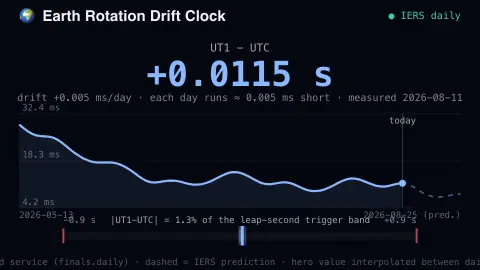
The Earth Rotation Drift Clock shows the live UT1−UTC offset — how far Earth's actual rotation has drifted from atomic time — from the IERS's daily earth-rotation series, with the drift per day, a chart including the official two-week prediction, and a gauge of the ±0.9 s leap-second band. It's free, needs an internet connection, and ESC exits.
Live preview
Press ESC to leave fullscreen. Settings are saved in your browser only.
How the Earth Rotation Drift Clock screensaver works
The pipeline pulls the IERS rapid-service series (USNO finals.daily) into content/ut1drift.json — about three months of real daily UT1−UTC values plus the IERS ~two-week prediction.
The hero readout interpolates between the daily points to the current moment, always signed and shown to four decimals of a second.
The chart draws measured days as a solid line and the prediction tail dashed and dimmer, with today marked; the drift-per-day figure says how much longer or shorter than 86,400 s the day is running.
A gauge places the current offset inside the ±0.9 s band — when |UT1−UTC| threatens that limit, the IERS schedules a leap second.
UT1, UTC and the IERS
There are two ways to define the length of a second. Atomic clocks count the vibrations of caesium atoms and give an extremely steady time scale. Astronomical time, called UT1, is tied to the actual rotation of the Earth, which is not perfectly constant: tides, the movement of the atmosphere and oceans, and processes in the Earth’s interior all change the rotation rate. Coordinated Universal Time, UTC, runs on atomic seconds but is kept close to UT1 by inserting leap seconds when needed.
The International Earth Rotation and Reference Systems Service, or IERS, monitors the planet’s orientation and publishes the difference UT1 minus UTC in bulletins and daily files, along with short-term predictions. Rapid-service values are provisional and are later replaced by final, more precise numbers, so the most recent days are the most likely to change.
The aim is to keep UT1 minus UTC within 0.9 seconds in absolute value, and the IERS is responsible for introducing leap seconds to do so. It announces whether one will occur in Bulletin C, issued each January and July, giving about six months’ notice. A positive value means UT1 is ahead of UTC, a negative one that it is behind. The future part of the graph is a prediction, not a measurement.
A worked example
Right now it reads UT1 − UTC = +0.0115 s, drifting about −0.019 ms per day — each day running a whisker longer than 86,400 atomic seconds — with the marker sitting at 1.3% of the leap-second band. Run it next to Leap Second Watch in Multi-view: the archive of past leap seconds beside the live dial that decides the next one.
Settings & tips
- Leap-second gauge — hides the ±0.9 s band strip if you'd rather give the chart the full height, e.g. in short, wide Multi-view cells.
Frequently asked questions
- Is this real, live data?
- Yes. The values are the IERS rapid-service earth-orientation measurements (published daily as finals.daily), fetched by the site's pipeline. The on-screen value is interpolated between daily points, and the badge shows when the feed is connected.
- Why does Earth's rotation speed wobble?
- Angular momentum is constantly traded between the solid Earth, its molten core, the oceans and the atmosphere — tides, winds, ice and even large earthquakes all nudge the day's length by milliseconds. That's why UT1 drifts against uniform atomic time.
- What happens if the offset reaches ±0.9 seconds?
- The IERS inserts a leap second into UTC to pull civil time back toward Earth's rotation — that's the band the gauge shows. With Earth spinning unusually fast lately, timekeepers are seriously debating the first-ever negative leap second, a minute with only 59 seconds.
- How is this different from the Leap Second Watch saver?
- Leap Second Watch is the historical archive — every leap second since 1972. This is the live instrument: the current UT1−UTC offset, its daily drift and the prediction of where it's heading.
- Is it free, and does it need a key?
- Yes, free — no key, no download, in your browser. It needs an internet connection to read the pipeline feed; ESC exits at any time.
- Why does the length of a day vary?
- Earth’s rotation speed changes irregularly. Tidal friction slows it over the long term, and other factors such as crust and mantle motion and redistribution of mass can slow or speed it.
- Who decides on leap seconds?
- The IERS. It announces whether one will be added in Bulletin C, published each January and July, which gives roughly six months’ notice.
- Are leap seconds going away?
- In 2022 the General Conference on Weights and Measures decided that the maximum allowed UT1 minus UTC difference will be increased in, or before, 2035, which would reduce the need for leap seconds. Check the BIPM for the latest status.