Every Kind of Twilight Screensaver
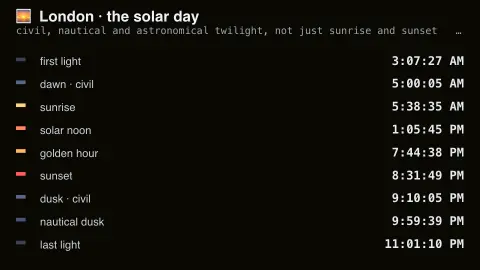
The Every Kind of Twilight screensaver shows the complete solar day for a city, key-less. Nautical twilight is named for when the horizon is still visible at sea; astronomical twilight is when telescopes can finally work. At high latitudes in midsummer some of these never arrive, and those rows are dropped rather than faked. It's free, runs in your browser, and ESC exits.
Live preview
Press ESC to leave fullscreen. Settings are saved in your browser only.
How the Every Kind of Twilight screensaver works
The saver reads the source described above and draws it on a canvas — no account, no tracking.
The complete solar day for a city, key-less. Nautical twilight is named for when the horizon is still visible at sea; astronomical twilight is when telescopes can finally work. At high latitudes in midsummer some of these never arrive, and those rows are dropped rather than faked.
It refreshes on a schedule, so what you see stays current.
Colours and any options can be changed in settings; nothing is stored beyond your own browser.
The three kinds of twilight
Twilight is the stretch between day and night when the Sun is below the horizon but still lights the sky by scattering. It is divided by how far the Sun’s centre is below the horizon. Civil twilight runs from sunset until the Sun is 6 degrees down, with enough light left that artificial light is generally unnecessary outdoors. Nautical twilight spans 6 to 12 degrees, when sailors can no longer reliably see the horizon, and astronomical twilight spans 12 to 18 degrees, after which the sky is dark enough to observe stars.
How long each phase lasts depends on latitude and season. At the equator the Sun’s path is nearly perpendicular to the horizon, so civil twilight can last as little as 24 minutes, against 33 to 48 minutes at Greenwich depending on the season. Above about 48.6 degrees north or south, near the summer solstice, twilight can last from sunset to sunrise, so full darkness never arrives. Some phases therefore simply do not occur, which is why the saver drops those rows.
The times shown are calculated for the city’s coordinates from the Sun’s position, and ignore weather, terrain and light pollution. A hilly horizon can bring sunset earlier, and a bright city sky will not look fully dark even in astronomical night.
A worked example
The complete solar day for a city, key-less. Nautical twilight is named for when the horizon is still visible at sea; astronomical twilight is when telescopes can finally work. At high latitudes in midsummer some of these never arrive, and those rows are dropped rather than faked.
Settings & tips
- City changes what the saver shows.
- Accent and Background recolour the display.
- Every value on screen comes from the live source — nothing is simulated.
- Press ESC to leave fullscreen.
Frequently asked questions
- Is this real data?
- Yes — it comes from the source named on this page and is refreshed on a schedule.
- Is a key needed?
- No. This source is fully key-less.
- Is it free?
- Yes, and it runs entirely in your browser.
- Why is twilight longer in summer at high latitudes?
- The Sun’s path is shallow there, so it takes much longer to sink the required number of degrees below the horizon.
- What counts as true darkness?
- Night proper begins when astronomical twilight ends, with the Sun more than 18 degrees below the horizon. Faint objects such as nebulae and galaxies may still need darker skies than a city offers.
- Do the times account for hills or clouds?
- No. They are calculated for a flat horizon from the Sun’s position, so local terrain and weather will change what you see.