Daylight Clock Screensaver
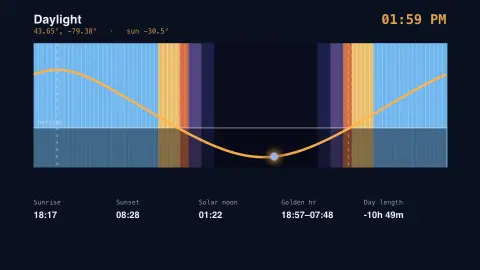
The Daylight Clock screensaver draws the Sun's arc across the day for your location — sunrise, sunset, golden hour and blue hour — computed on your device from the date and time. It needs no feed, runs in your browser, and ESC exits.
Live preview
Press ESC to leave fullscreen. Settings are saved in your browser only.
How the Daylight Clock screensaver works
The saver computes the Sun's altitude through the whole day for your location, using standard solar-position equations on your device.
From that curve it finds sunrise, sunset, solar noon and the twilight bands, with no data feed required.
The day is drawn as a colored band — night, dawn, golden hour, daylight, dusk — with a marker creeping along it at the current time.
Sunrise, sunset, golden hour and the length of the day are called out and update as the day goes on.
Solar time, twilight and the golden hour
Daylight lengths come from the geometry of a tilted Earth. The planet’s axis is inclined about 23.4 degrees relative to its orbit, so the Sun’s noon height and the length of the day shift through the year. At the equator day length hardly changes, while far from it the swing grows until, within the polar circles, the Sun does not set at all around midsummer.
The coloured bands follow conventional definitions. Sunrise and sunset are timed to the Sun’s upper edge crossing the horizon, with an allowance for atmospheric refraction, which makes the Sun appear higher than it geometrically is. Civil, nautical and astronomical twilight end when the Sun’s centre is 6, 12 and 18 degrees below the horizon, as the US National Weather Service defines them, after which the sky is considered fully dark.
Golden hour and blue hour are photographers’ terms rather than official ones, so their exact limits vary between sources. Golden hour is the period when the Sun is low and the light is warm and soft; blue hour is the deep blue twilight just before sunrise or after sunset. Real conditions deviate from a calculation: hills, cloud and haze change what you actually see, and at high latitudes some twilight stages may not occur on a given date.
A worked example
The band glows through dawn into a long midsummer day and back to dusk, the now-marker sliding along the Sun's altitude curve, with the times spelled out — Sunrise 5:24 · Sunset 8:31 · Day 15h 07m.
Settings & tips
- Location sets the latitude and longitude the Sun is computed for.
- Sun color recolours the arc and markers.
- Background sets the panel backdrop.
Frequently asked questions
- Is it accurate for my location?
- Yes. It uses standard solar equations for the location you choose, so sunrise, sunset and golden hour match real almanac times closely.
- Does it need a connection?
- No. Everything is computed on your device, so the daylight clock runs fully offline.
- What is golden hour?
- Golden hour is the period after sunrise and before sunset when the Sun is low and the light is warm — the saver marks it on the day band.
- Which locations can I pick?
- A built-in set of major cities; each sets the latitude and longitude the Sun's path is drawn for.
- Is it free?
- Yes — free, no download, no key, in your browser.
- Why is the longest day not the earliest sunrise?
- At mid-latitudes the earliest sunrise comes a few days before the June solstice and the latest sunset a few days after it. The cause is the equation of time: solar noon drifts against clock noon through the year.
- What counts as the end of twilight?
- Astronomical twilight ends when the Sun’s centre is 18 degrees below the horizon. After that the sky is considered fully dark, though artificial light can still wash out the stars.