Sidereal Clock Screensaver
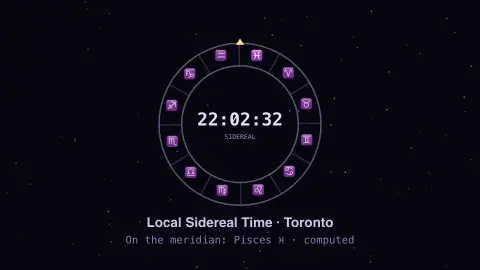
The Sidereal Clock screensaver shows Local Sidereal Time — the clock astronomers use — on a slowly turning zodiac wheel showing which stars are overhead right now, computed from your longitude. It's free, runs in your browser, and ESC exits.
Live preview
Press ESC to leave fullscreen. Settings are saved in your browser only.
How the Sidereal Clock screensaver works
The saver computes Local Sidereal Time from the date and your longitude — the time kept by the stars rather than the Sun.
Sidereal time runs about four minutes faster a day than clock time, because Earth turns relative to the stars slightly quicker than relative to the Sun.
A zodiac wheel turns so the constellation currently crossing your meridian sits at the top.
Choose your city; everything is computed locally.
Why astronomers keep star time
A solar day is the time for the Sun to return to the same position in the sky, about 24 hours. A sidereal day is the time for Earth to rotate once relative to the distant stars, about 23 hours 56 minutes 4 seconds. The difference arises because Earth also moves along its orbit during the day, so it has to turn a little extra to bring the Sun back to the meridian.
Local Sidereal Time is the right ascension of the stars currently crossing your local meridian, the imaginary line from north to south through the point overhead. That makes it practical: an object whose right ascension equals the local sidereal time is crossing the meridian, which is where it is highest in the sky. Observatories have long used sidereal clocks, and telescope control systems convert between the two kinds of time.
Because sidereal time depends on longitude, two people at different longitudes at the same instant have different values, whereas clock time is set by time zones for convenience. In a year Earth rotates once more relative to the stars than relative to the Sun, so the sidereal clock gains one full day on the civil clock, which is why the night sky changes with the seasons.
A worked example
The readout shows a sidereal time of 21:47:05 for Toronto, the zodiac wheel turned so Aquarius rides the meridian overhead — the sky's own clock, ahead of your wall clock by a few minutes more each night.
Settings & tips
- Location sets your longitude, defaulting to Toronto.
- Background sets the starry backdrop.
- The wheel marks the sign now crossing your meridian.
Frequently asked questions
- What is sidereal time?
- It's time measured by the stars — when the same star returns to your meridian. Astronomers use it to point telescopes.
- Why does it differ from my clock?
- Earth turns relative to the stars about four minutes faster a day than relative to the Sun, so sidereal time slowly pulls ahead.
- Does it need a connection?
- No. It's all computed from your longitude on your device, so it runs fully offline.
- Does my location matter?
- Yes. Local Sidereal Time depends on your longitude, so picking your city makes the overhead constellation correct.
- Is it free?
- Yes — free, no download, no key, in your browser.
- How much does a sidereal clock gain on a normal clock?
- About four minutes a day, which adds up to one extra full rotation over a year. This is why a star rises about four minutes earlier each night.
- What is right ascension?
- It is the east-west coordinate on the sky, measured in hours, minutes and seconds from the vernal equinox. Together with declination it works like longitude and latitude for the heavens.
- Why does the best time to observe an object change through the year?
- A given right ascension reaches your meridian when local sidereal time equals it. Because sidereal time runs ahead of civil time, that moment shifts earlier on the clock as the months pass.