Daylight Saving Countdown Screensaver
The Daylight Saving Countdown screensaver counts down to the next real daylight saving time transition, computed from the real calendar rules used across major time zones. It is free, runs in your browser, and ESC exits.
Live preview
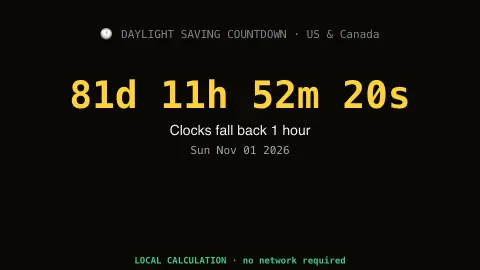
Press ESC to leave fullscreen. Settings are saved in your browser only.
How the Daylight Saving Countdown screensaver works
The saver computes the next real daylight saving time transition using the real calendar rule for the selected region.
A live countdown ticks down to the real moment clocks change.
The computation runs entirely in your browser — no network fetch is needed.
Regions that do not observe daylight saving are also supported, showing a real "not observed" state.
How daylight saving rules are set
Daylight saving time moves clocks forward in the warmer months so that evening light lasts longer, and back again later. Benjamin Franklin's 1784 letter to a Paris newspaper joked that Parisians could save candles by rising earlier, but it did not propose changing the clocks. The German and Austro-Hungarian Empires were the first to adopt the practice nationwide, in April 1916, to conserve coal during the First World War, and the United Kingdom followed in May 1916.
The rules are set by law and differ by country. Since 2007 most of the United States and Canada have observed daylight saving from the second Sunday in March to the first Sunday in November, with clocks changing at 2 a.m. local time. European Summer Time runs from the last Sunday in March to the last Sunday in October, and EU members change clocks at the same instant, 01:00 UTC, so time differences between European zones stay constant. In the Southern Hemisphere the seasons are reversed, so the dates are roughly reversed too.
Because the rules are legislated, a new law can change them, and a countdown has to follow the rules currently in force. Some places also differ within one country: Arizona does not observe daylight saving, apart from the Navajo Nation.
A worked example
In a region observing daylight saving, the countdown reaches the real second clocks are due to spring forward or fall back, then resets to the next real transition.
Settings & tips
- Accent recolours the countdown digits.
- The transition dates follow each region's real legal calendar rule.
- No internet connection is required — the math runs locally.
Frequently asked questions
- Is this a real countdown?
- Yes — it computes the real next daylight saving transition from real calendar rules.
- Is a key needed?
- No — it is a pure local calculation.
- What if my region doesn't observe DST?
- A real "not observed" state is shown instead of a countdown.
- Is it free?
- Yes — free, no download, in your browser.
- Why does the date move around between countries?
- Each jurisdiction sets its own rules by law, so the weekend and the hour of the change can differ. The US changes at 2 a.m. local time, while EU members change together at 01:00 UTC.
- Who started daylight saving?
- Several people proposed the idea, but Germany and Austria-Hungary were the first to adopt it nationwide, in April 1916, to save coal in the First World War. The United Kingdom followed in May 1916.
- Did Benjamin Franklin invent it?
- Not really. His 1784 letter was a satire about saving candles by waking earlier and did not suggest moving the clocks.