Leap Second Watch Screensaver
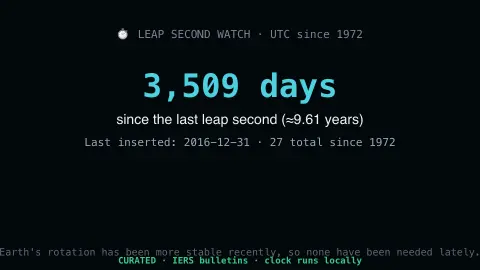
The Leap Second Watch screensaver shows the real history of every leap second added to civil time since 1972, from the International Earth Rotation and Reference Systems Service. It is free, runs in your browser, and ESC exits.
Live preview
Press ESC to leave fullscreen. Settings are saved in your browser only.
How the Leap Second Watch screensaver works
The saver displays the real, complete published history of every leap second inserted into UTC since 1972.
A live running clock shows real elapsed time since the most recent leap second.
The record is a real, curated list from the International Earth Rotation and Reference Systems Service's own bulletins.
No live feed is required for the historical record; the clock runs locally.
Why civil time has an occasional extra second
Two clocks are being reconciled here. International Atomic Time is kept by atomic clocks and ticks at a steady rate. Earth's rotation, which defines solar time, is slightly irregular and has tended to slow over the long run, so the two drift apart. Coordinated Universal Time, the basis of civil time, is kept close to Earth-rotation time by occasionally adding a leap second.
The International Earth Rotation and Reference Systems Service monitors Earth's orientation and announces in its Bulletin C whether a leap second will be inserted. Insertions fall on 30 June or 31 December, usually announced about six months ahead. The extra second is written 23:59:60, and software that assumes every minute has exactly 60 seconds can fail on it. The UTC standard also allows a negative leap second, but none has ever been used. Between 1972 and the most recent insertion at the end of 2016, 27 were added.
The running clock here counts elapsed time since the most recent insertion. A long gap does not mean the practice has been abandoned in principle, because Earth's rotation varies unpredictably, but in 2022 the General Conference on Weights and Measures voted to enlarge the permitted gap between the two time scales so that leap seconds could stop by 2035. The historical list is a record of past decisions, not a schedule.
A worked example
The real gap of several years since the last leap second, reflecting Earth's recently more stable rotation rate, is shown by the live running clock.
Settings & tips
- Accent recolours the running clock.
- Every date is a real, officially inserted leap second.
- Leap seconds are scheduled irregularly, based on real measured Earth rotation.
Frequently asked questions
- Is this a real historical record?
- Yes — every leap second since 1972, from the official real IERS bulletins.
- Is a key needed?
- No — the record is a curated real list and the clock runs locally.
- Why do leap seconds happen?
- Earth's real rotation is slightly irregular, so leap seconds keep UTC aligned with it.
- Is it free?
- Yes — free, no download, in your browser.
- Has a leap second ever been removed?
- No. The UTC standard allows a negative leap second if Earth rotated faster than atomic time, but every leap second so far has been an added one.
- How do computers handle the extra second?
- Approaches differ. Some systems display 23:59:60, and companies including Google and Amazon have spread the extra second over many hours, a technique called smearing that was never standardized, so schemes vary.
- Do GPS clocks have leap seconds?
- No. GPS time does not follow leap seconds and stays a fixed 19 seconds behind International Atomic Time, so its offset from UTC changes whenever a leap second is added.