Equinox & Solstice Countdown Screensaver
The Equinox & Solstice Countdown screensaver counts down to the next real equinox or solstice, computed from real published astronomical timing tables. It is free, runs in your browser, and ESC exits.
Live preview
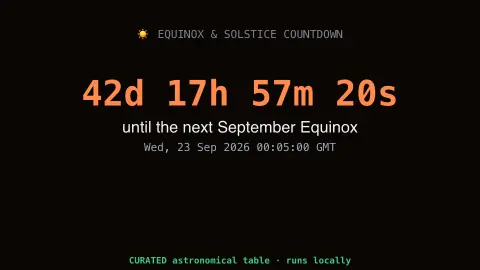
Press ESC to leave fullscreen. Settings are saved in your browser only.
How the Equinox & Solstice Countdown screensaver works
The saver looks up the real published UTC moment of the next equinox or solstice from an astronomical timing table.
A live countdown ticks down to that real exact moment.
Once passed, the saver automatically advances to the next real seasonal marker.
The computation runs entirely in your browser — no network fetch is needed.
Why the equinoxes and solstices move
Seasons exist because Earth’s axis is tilted, by about 23.4 degrees, relative to its orbit. The two solstices mark the points where one hemisphere leans most toward or away from the Sun, giving the longest and shortest days. The two equinoxes are the moments when the Sun crosses the celestial equator, so the Sun’s centre spends about equal time above and below the horizon.
Each is a single instant, not a whole day. Astronomers define the equinox by the Sun’s apparent ecliptic longitude reaching 0 degrees (March) or 180 degrees (September), and the solstices at 90 and 270 degrees. Because the year is not a whole number of days, the moment falls about six hours later each year, then jumps back after a leap year. In this century the March equinox falls on 19 to 21 March in UT, and the September equinox on 21 to 23 September.
The exact UTC time is the same for everyone, but the local date and clock reading depend on your time zone, so a moment late on one day in New York may fall on the next day in Tokyo. The seasons also swap between hemispheres: the March equinox begins spring in the north and autumn in the south. Meteorological seasons, used in weather statistics, begin on fixed calendar dates instead.
A worked example
As the countdown reaches zero at the real published moment of the solstice, the display automatically advances to count down to the real next equinox.
Settings & tips
- Accent recolours the countdown digits.
- Timings are the real precise UTC moments, not just calendar dates.
- No internet connection is required — the lookup runs locally.
Frequently asked questions
- Is this a real countdown?
- Yes — it counts down to the real published UTC moment of each equinox and solstice.
- Is a key needed?
- No — it uses a local, pre-loaded real astronomical table.
- Why isn't the date always the same?
- Equinoxes and solstices shift by about a real day each year due to the calendar and leap years.
- Is it free?
- Yes — free, no download, in your browser.
- Why does the countdown read a different date in my time zone?
- The event happens at one instant worldwide, but a clock in a different time zone assigns it to a different local day.
- Are day and night exactly equal on the equinox?
- Not quite. Sunrise and sunset are defined by the Sun’s upper edge, and atmospheric refraction lifts the Sun’s disk, so daylight is slightly longer than night, by about 14 minutes at the equator.
- What is the difference between astronomical and meteorological seasons?
- Astronomical seasons start at the equinoxes and solstices. Meteorological seasons use whole calendar months, such as December to February for winter in the northern hemisphere, to keep records simple.