Lunar New Year Countdown Screensaver
The Lunar New Year Countdown screensaver counts down to the next real Lunar New Year, using the real published dates of the Chinese lunisolar calendar. It is free, runs in your browser, and ESC exits.
Live preview
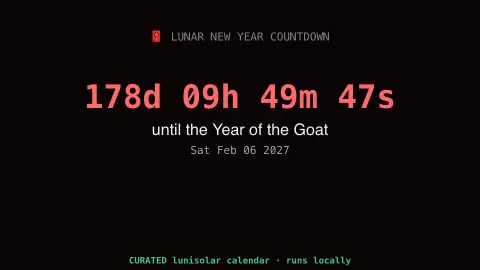
Press ESC to leave fullscreen. Settings are saved in your browser only.
How the Lunar New Year Countdown screensaver works
The saver looks up the next real Lunar New Year date from a pre-loaded table of published lunisolar calendar dates.
A live countdown ticks down to that real date at local midnight.
The upcoming year's real zodiac animal is shown alongside the countdown.
The computation runs entirely in your browser — no network fetch is needed.
Why Lunar New Year moves
Lunar New Year falls on a new moon between 21 January and 20 February in the Gregorian calendar. The traditional Chinese calendar is lunisolar: months follow the Moon, and an intercalary (leap) month is added in some years to keep the calendar aligned with the solar year, which is why the date wanders.
The month containing the winter solstice is the eleventh month, and the new year usually falls on the second new moon after that solstice. When an intercalary month intervenes it can be the third. Because the new moon is calculated for a specific time zone, communities that compute it differently can occasionally disagree: Vietnam, which uses UTC+7 rather than China’s UTC+8, has at times celebrated Tết on a different day from Chinese New Year.
The festival goes by different names, such as Chunjie in China, Seollal in Korea and Tết in Vietnam. The Lantern Festival on the 15th day of the new year marks the end of the festivities. Each year is assigned an animal in a repeating 12-year cycle, so the zodiac animal changes every year and the same animal returns after twelve.
A worked example
As the countdown reaches zero on the real Lunar New Year's Eve, the display automatically advances to count down to the following year's real date.
Settings & tips
- Accent recolours the countdown digits.
- Dates follow the real published Chinese lunisolar calendar.
- No internet connection is required — the lookup runs locally.
Frequently asked questions
- Is this a real date?
- Yes — it uses the real published Lunar New Year dates from the Chinese lunisolar calendar.
- Is a key needed?
- No — it uses a local, pre-loaded real calendar table.
- Why does the date change each year?
- The Lunar New Year follows the real lunisolar calendar, so its Gregorian date shifts yearly.
- Is it free?
- Yes — free, no download, in your browser.
- Why is the date not the same each year?
- It is tied to the Moon’s phases in a lunisolar calendar, so the Gregorian date shifts from year to year but always lands on a new moon between 21 January and 20 February.
- Do all countries celebrate on the same day?
- Usually, but not always. The new moon is calculated for a particular time zone and calendar convention, so places such as Vietnam and China have occasionally had different dates.
- What is a leap month?
- An extra month inserted in some years of the Chinese calendar so that the lunar months stay aligned with the solar year and the seasons.