Sundial Screensaver
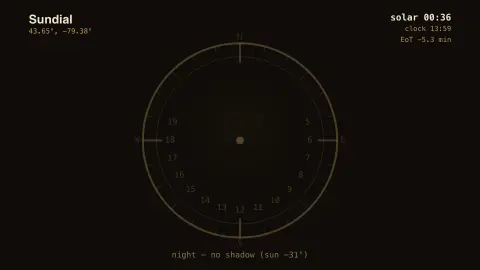
The Sundial screensaver is a working sundial that casts the gnomon's shadow to the Sun's true position right now, marking solar time and the analemma, computed on your device from the date and time. It needs no feed, runs in your browser, and ESC exits.
Live preview
Press ESC to leave fullscreen. Settings are saved in your browser only.
How the Sundial screensaver works
The saver computes the Sun's current altitude and azimuth for your location with standard solar equations, on your device.
A gnomon casts its shadow in the opposite direction to the Sun, lengthening near sunrise and sunset just as a real dial's would.
Hour lines mark solar time, and the difference between sundial time and clock time — the equation of time — is shown.
When the Sun is below the horizon the dial dims to a night state, and the analemma figure-eight can be drawn across the face.
How a sundial tells solar time
A sundial reads apparent solar time, the time defined by the Sun’s actual position over your longitude. The gnomon, the part that casts the shadow, is normally tilted so it points at the celestial pole, which makes the shadow turn at a uniform rate of fifteen degrees per hour. A flat horizontal dial like the one drawn here instead needs unevenly spaced hour lines.
Solar time rarely agrees with a wristwatch. The Earth’s orbit is elliptical and its axis is tilted, so the Sun runs ahead of or behind a perfectly steady clock, by up to about sixteen minutes ahead in early November and about fourteen minutes behind in mid-February. This offset is the equation of time. Added to it is a correction for how far you are from the central meridian of your time zone, and an hour of daylight saving where it applies.
The analemma, the figure-eight, traces where the Sun appears at the same clock time throughout a year. Its east-west width is the equation of time, and its height follows the Sun’s changing declination between the solstices. Because dial time and clock time differ, many sundials carry a correction table or a curved scale to translate shadow time into clock time.
A worked example
Through the day the shadow swings around the dial and shortens toward noon, reading solar time that runs a few minutes off the clock. Switch on the analemma and the Sun's noon positions trace the famous figure-eight across the face.
Settings & tips
- Location sets where the Sun's position is computed for.
- Show analemma draws the Sun's figure-eight of noon positions.
- Dial color recolours the sundial.
Frequently asked questions
- Does it tell the real time?
- It tells real solar time — what a sundial reads — which differs from clock time by a few minutes (the equation of time), shown on the dial.
- Does it need a connection?
- No. The Sun's position is computed on your device, so the sundial runs fully offline.
- What is the analemma?
- It's the figure-eight the Sun traces if you mark its position at clock-noon through the year, caused by Earth's tilt and elliptical orbit.
- What happens at night?
- When the Sun is down the dial dims and shows a night state, since there's no shadow to cast.
- Is it free?
- Yes — free, no download, no key, in your browser.
- Why does my sundial disagree with my watch?
- Your watch keeps mean time for a whole time zone, while a sundial shows true solar time for your exact longitude. The difference changes through the year, and the equation of time alone reaches about sixteen minutes.
- Why do horizontal dials have uneven hour lines?
- The shadow of a tilted gnomon sweeps a flat horizontal surface at different rates depending on the angle. The hour lines are therefore closer together near noon and spread wider toward morning and evening.