Mars Clock Screensaver
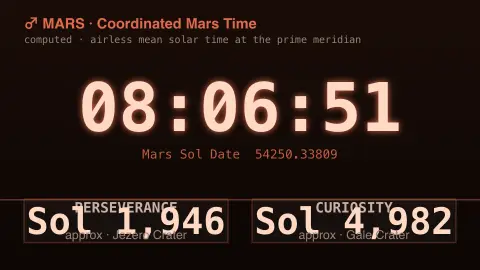
The Mars Clock screensaver shows Mars Coordinated Time computed from the Martian sol, with the mission-clock sol counts for the Perseverance and Curiosity rovers. It's computed on your device, runs in your browser, and ESC exits.
Live preview
Press ESC to leave fullscreen. Settings are saved in your browser only.
How the Mars Clock screensaver works
The saver computes Mars Coordinated Time (MTC) — the mean solar time at the Martian prime meridian — from the current date.
A Martian day, or sol, is about 24 hours 39 minutes, so the clock drifts slowly against Earth time.
It also tallies the mission sols for NASA's Perseverance and Curiosity rovers, counting up from their landing dates.
Everything is computed locally on your device, so it needs no connection.
Keeping time on Mars
A Martian solar day, called a sol, lasts about 24 hours 39 minutes 35 seconds of Earth time, roughly 2.75% longer than an Earth day. Mars Coordinated Time (MTC) is a proposed standard defined as the mean solar time at Mars’s prime meridian, running through the crater Airy-0, analogous to UT1 on Earth. It has not been used in mission timekeeping, and each lander has instead used its own offset from local solar time at its site.
Mission teams often worked on “Mars time”, so their schedules drifted about 40 minutes later in Earth time each day. Sol counting also differs between missions: Viking, Phoenix, Curiosity, InSight and Perseverance counted touchdown as Sol 0, while Pathfinder, Spirit and Opportunity counted it as Sol 1. Sol counts differ between missions because they landed on different dates.
A Martian year is about 687 Earth days, or roughly 669 sols. Because Mars’s orbit is more eccentric than Earth’s, the Sun can run up to about 51 minutes slower or 40 minutes faster than a Martian mean clock, a far larger equation of time than Earth’s range of roughly 14 minutes slower to 16 minutes faster.
A worked example
The clock reads an MTC of 14:48:30, a Mars Sol Date ticking up below it, and two mission counters — Perseverance Sol 1,9xx and Curiosity Sol 4,4xx — climbing over their dusty Martian horizon.
Settings & tips
- Accent recolours the Martian readouts.
- Background sets the dusty backdrop.
- The seconds tick in real time, computed locally.
Frequently asked questions
- Is the Mars time accurate?
- Yes. Mars Coordinated Time is computed from the standard Mars Sol Date formula, accurate to within seconds.
- What is a sol?
- A sol is one Martian day — about 24 hours 39 minutes 35 seconds, a little longer than an Earth day.
- Are the rover sols exact?
- They're computed from each rover's landing date, so they're approximate mission-sol counts, very close to NASA's own.
- Does it need a connection?
- No. Everything is calculated on your device, so it runs fully offline.
- Is it free?
- Yes — free, no download, no key, in your browser.
- How long is a Martian year?
- About 687 Earth days, which is roughly 669 sols.
- Why did rover teams live on Mars time?
- Rovers work in daylight and send data at set points in the Martian day, so aligning the team’s schedule with the sol made the work easier. It also meant the shift drifted about 40 minutes later each day on Earth’s clock.
- Does Mars have time zones?
- No standard ones. Mars Coordinated Time is a proposal for the prime meridian, and each lander has used its own offset from local solar time at its site.