Space Debris Count Screensaver
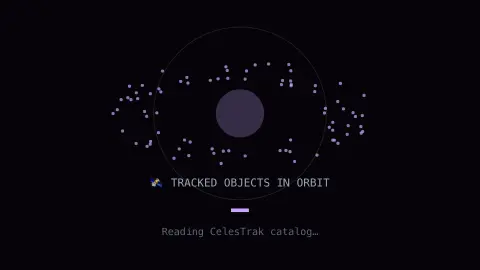
The Space Debris Count screensaver shows the real, current number of tracked objects in Earth orbit — payloads, rocket bodies and debris — drawn key-less and live from CelesTrak's satellite catalog. It's free, runs in your browser, and ESC exits.
Live preview
Press ESC to leave fullscreen. Settings are saved in your browser only.
How the Space Debris Count screensaver works
The saver fetches CelesTrak's current satellite catalog summary, with no key required.
A large counter shows the real total number of tracked objects currently in orbit.
An optional breakdown splits the total into active payloads, rocket bodies and debris.
Orbiting dots drift slowly across the display, one representing many, to suggest the real scale.
How orbital objects get counted
Space surveillance networks track objects in orbit with radar and optical telescopes, and the positions are published as orbital element sets. CelesTrak, a public service run by Dr T.S. Kelso, publishes its own satellite catalogue (SATCAT) and a box score that counts entries by country or organisation. Each count is split into payloads, debris and all objects, and into on orbit and decayed, with active payloads shown as a subset of payloads on orbit.
What the counter shows is the tracked population: objects large enough to be followed reliably, which in low orbit means roughly 10 cm and up, with larger minimum sizes at higher altitudes. ESA's statistical models estimate more than a million additional pieces of debris between 1 and 10 cm, and far more smaller ones, none of them in the catalogue. Even small fragments move at several kilometres per second, so they can damage spacecraft.
The number rises with launches, large constellations of small satellites, and fragmentation events that create clouds of new pieces. It falls when objects reenter and are marked decayed, which happens fastest at low altitudes where atmospheric drag is strongest. A count is not a measure of risk by itself, since risk depends on where objects sit in altitude and orbit.
A worked example
The total ticks upward over months as real launches and fragmentation events add tracked objects — a genuine reflection of the catalog, not a fixed prop number.
Settings & tips
- Category breakdown toggles the payload/rocket-body/debris split.
- Accent recolours the counter and dots.
- The catalog only includes objects large enough to track — the true debris count is far higher.
Frequently asked questions
- Does this include every piece of space junk?
- No — only objects large enough for ground radar to catalog. Millions of smaller untracked fragments also exist.
- Is a key needed?
- No. CelesTrak's catalog data is free and key-less.
- How often does the count change?
- It grows with new launches and shrinks slowly as objects decay from orbit — real, if gradual, movement.
- Is it free?
- Yes — free, no download, in your browser.
- Why can't every fragment be tracked?
- Radars and telescopes have a detection limit that depends on size and distance. Smaller pieces exist but are not in the public catalogue; ESA models estimate over a million between 1 and 10 cm.
- Does a satellite count disappear when it reenters?
- The catalogue marks objects as decayed once they reenter, and the box score lists on orbit and decayed counts separately, so the on-orbit total reflects objects still up there.
- Do high orbits clean themselves up?
- Much more slowly than low ones. Atmospheric drag is strongest at low altitude, so debris there decays sooner, while objects at much higher altitudes can stay in orbit for very long periods.