Exoplanet Habitability Index Screensaver
The Exoplanet Habitability Index screensaver ranks real confirmed exoplanets by their published habitability potential. It is free, runs in your browser, and ESC exits.
Live preview
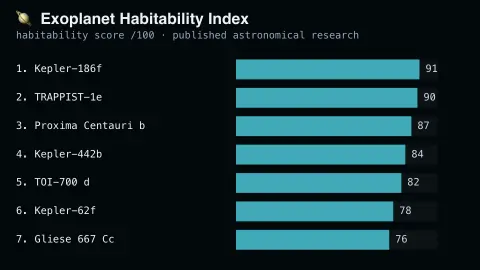
Press ESC to leave fullscreen. Settings are saved in your browser only.
How the Exoplanet Habitability Index screensaver works
The saver displays a real, curated ranking of confirmed exoplanets by published habitability research.
Each planet shows its real host star, real distance from Earth and real habitability rating.
The board refreshes periodically as new real exoplanet research is published.
No live feed is required — figures are a real, curated periodic snapshot.
What habitability rankings can and cannot say
An exoplanet is a planet orbiting a star other than the Sun. Habitability rankings try to compare them by how Earth-like their conditions might be. The inputs are limited to what telescopes can measure, such as a planet's size or mass, its orbit, and the light and heat it receives from its star.
The key idea is the habitable zone, the band of orbits around a star where a planet's surface could potentially hold liquid water. Its inner edge is set by water boiling away under a greenhouse atmosphere and its outer edge by water freezing. One published index is the Earth Similarity Index, proposed by Schulze-Makuch and colleagues in 2011 in the journal Astrobiology. It scores a planet from 0 to 1, with Earth at 1, using radius, density, escape velocity and surface temperature, but it carries no quantitative meaning for habitability itself. The board shows each planet's host star, its distance from Earth and the published rating.
Habitability here means potential, not evidence. Red dwarf habitable zones lie very close to the star, and red dwarfs can produce large flares that could strip an otherwise habitable planet of its atmosphere and water. Ratings also change as measurements are refined.
A worked example
A real rocky exoplanet orbiting within its star's habitable zone ranks near the top, exactly matching published astrobiology research.
Settings & tips
- Accent recolours the ranking bars.
- Rankings are based on real published exoplanet research.
- Habitability potential does not confirm the presence of life.
Frequently asked questions
- Is this real exoplanet data?
- Yes — real, published research on confirmed exoplanets.
- Is a key needed?
- No — figures are a curated real periodic snapshot.
- Does this mean life has been found?
- No — habitability potential describes real conditions, not confirmed evidence of life.
- Is it free?
- Yes — free, no download, in your browser.
- What is the habitable zone?
- The band of orbits around a star where a planet's surface could potentially hold liquid water, depending on its distance and the star's output.
- Why are red dwarfs often mentioned alongside habitability?
- Their habitable zones sit very close to the star, so planets there are often tidally locked and exposed to flares that could strip an atmosphere.
- Can a high rating change?
- Yes. New measurements of a planet's size, mass or orbit can alter its score or ranking.