Gravitational Wave Alerts Screensaver
The Gravitational Wave Alerts screensaver shows real public candidate alerts from GraceDB, the alert database the LIGO, Virgo and KAGRA gravitational-wave detectors publish to, with each event's real classification probabilities and false-alarm rate. It's free, needs an internet connection, and ESC exits.
Live preview
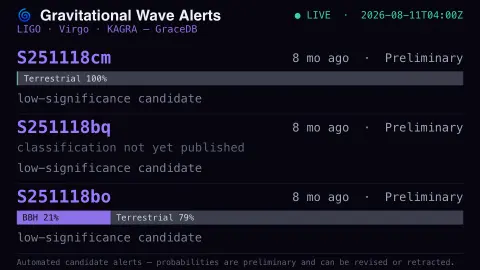
Press ESC to leave fullscreen. Settings are saved in your browser only.
How the Gravitational Wave Alerts screensaver works
A background pipeline reads GraceDB's public superevent list — the same key-less feed astronomers watch for follow-up targets.
Each card carries a real event id like S251118cm, how long ago the candidate was recorded, and its alert type.
The stacked bar splits the detection's own probabilities between a black-hole merger (BBH), a neutron-star merger (BNS), a mixed neutron-star/black-hole merger (NSBH) and terrestrial noise.
Distance appears in megaparsecs with a billion-light-year conversion when GraceDB has published it, and the false-alarm rate reads as one false alarm per so many years.
How a gravitational-wave alert is made
When two black holes or neutron stars spiral together and merge, they emit gravitational waves that change distances by tiny amounts: for the strongest waves, the end of a detector arm moves by at most roughly 10⁻¹⁸ metres. The two LIGO detectors in the United States (Louisiana and Washington state) each have two perpendicular arms 4 km long, and they work with Virgo in Italy and KAGRA in Japan. Candidates are announced publicly so that other observatories can follow them up.
In GraceDB, candidates from different search pipelines that are close in time are grouped into a single superevent, meant to represent one astrophysical source. Its name is S, then the six-digit UTC date (year, month, day), then lowercase letters. A preliminary alert is issued automatically within minutes and may later be retracted, while updates can follow hours, days or weeks later as analysis improves.
The false-alarm rate is how often noise alone would produce a candidate at least this strong. The LVK guide flags a compact-binary candidate as significant when its false-alarm rate, multiplied by a trials factor, is below one per month. The classification probabilities (BNS, NSBH, BBH and terrestrial) sum to one, depend on a model and prior merger rates, and can change in later updates.
A worked example
A card reading S251118cm · 99% Terrestrial tells you the pipeline thinks that candidate was almost certainly detector noise, not a merger — while an event dominated by a purple BBH segment with a false alarm rate of one per five million years is the kind that sends telescopes hunting. Drop it into Multi-view next to a sky map for an observatory wall.
Settings & tips
- Seconds per page sets how long each screenful of alerts holds before the list cycles to the next.
- Alerts are listed most recent first; on a small Multi-view cell fewer cards fit, so the cycling does more work.
- Run
automation/run.py gwalertson your pipeline machine to refresh the alert list.
Frequently asked questions
- Are these real detections?
- They're real published candidates — the automated alerts LIGO, Virgo and KAGRA release within minutes of a trigger. Many are later reclassified as noise or retracted, which is why the terrestrial probability is shown alongside the astrophysical ones.
- Does it need an API key?
- No. GraceDB's public superevent feed is key-less; a small background script fetches it and saves a snapshot the saver reads.
- Does it work offline?
- The last snapshot the pipeline saved will still draw, but new alerts need an internet connection to arrive.
- What does the false-alarm rate mean?
- It's how often detector noise alone would be expected to fake an event that loud — one per five million years means a very confident detection, one per few months means treat it as noise.
- Is it free?
- Yes — free, no download, in your browser.
- What is a superevent?
- It is GraceDB’s grouping of event candidates, possibly from different search pipelines, that are close in time and presumed to come from a single astrophysical source. One candidate is the preferred event, and the superevent keeps one name.
- What does a retraction mean?
- A retraction is issued when vetting finds that the candidate is probably not astrophysical. Preliminary alerts go out automatically within minutes, so some are withdrawn later.
- What does the terrestrial probability mean?
- It is the probability that the candidate is a chance background fluctuation or a detector glitch rather than a real merger. The four probabilities (BNS, NSBH, BBH, terrestrial) add up to one.