Supernova Discovery Feed Screensaver
The Supernova Discovery Feed screensaver tickers real recently reported supernovae and extragalactic transients, each with its host galaxy, brightness and discovery date, compiled from David Bishop's Latest Supernovae page at Rochester Astronomy. It's free, needs an internet connection, and ESC exits.
Live preview
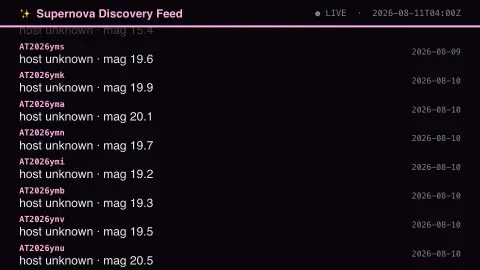
Press ESC to leave fullscreen. Settings are saved in your browser only.
How the Supernova Discovery Feed screensaver works
A background pipeline reads Rochester Astronomy's Latest Supernovae list — the long-running amateur-and-professional clearing house for new extragalactic transients.
Names follow the IAU's Transient Name Server convention: AT for an astronomical transient still awaiting classification, SN once it's confirmed as a supernova.
Each row shows the host galaxy where the star exploded (or that the host is unknown) plus its apparent magnitude — the smaller the number, the brighter it looks from Earth.
The right-hand column carries the discovery date, and the spectral type once someone has taken a spectrum.
How a new supernova gets its name
Most supernova discoveries today come from automated sky surveys that photograph large areas of sky night after night and compare each image to an older reference. Anything that has brightened is flagged, checked, and reported to the Transient Name Server, the IAU’s official mechanism for reporting new transients since 2016, which assigns an official designation. The Rochester Astronomy list maintained by David Bishop gathers recent reports in one readable place.
A designation is a prefix, the year and a run of letters: the first 26 objects of the year get single letters, then come pairs (aa, ab and so on), then triples. A newly reported object keeps the AT prefix, for astronomical transient, until it has been classified by spectroscopy. If it is confirmed as a supernova of any type, the prefix changes to SN. Many entries here are still unclassified for this reason.
Apparent magnitude runs backwards, so a larger number means a fainter object, and most discoveries sit far beyond naked-eye brightness, in distant galaxies. The host galaxy is the home of the explosion, and it may be catalogued only by a survey number. Early magnitudes are rough, and the same event is often reported by several surveys, so alternate names are common.
A worked example
A row reading AT2026wfl · in M31 · mag 20.0 is a transient spotted in the Andromeda galaxy at magnitude 20 — far too faint for the eye, an easy target for a modest telescope with a camera. Most rows arrive as AT and only later become SN, once a spectrum settles what actually blew up.
Settings & tips
- Feed speed controls how quickly new rows ease up the screen.
- Magnitude runs backwards: magnitude 14 is roughly 250 times brighter than magnitude 20.
- Run
automation/run.py supernovafeedon your pipeline machine to refresh the list.
Frequently asked questions
- Are these real supernovae?
- Yes — real reported discoveries collated by Rochester Astronomy, named through the IAU's Transient Name Server. Entries marked AT are genuine transients that haven't been spectroscopically classified yet.
- Does it need an API key?
- No. The source page is public and key-less; a small background script reads it and saves a snapshot the saver loads.
- Does it work offline?
- The last snapshot still displays offline, but fresh discoveries need an internet connection.
- Could I see one of these myself?
- Sometimes. Anything brighter than about magnitude 15 is within reach of a backyard telescope with a camera; the fainter rows need professional gear.
- Is it free?
- Yes — free, no download, in your browser.
- Why do so many entries have no type listed?
- A type requires a spectrum, and spectra take telescope time that is scarce compared with the number of discoveries. Objects keep the AT prefix until they are classified.
- What separates a Type Ia from a Type II supernova?
- Astronomers sort supernovae by spectrum: Type II shows hydrogen lines and Type I does not. Type Ia comes from runaway fusion in a white dwarf, while Type II comes from the core collapse of a massive star.
- Is every listed object definitely a supernova?
- No. Until a spectrum confirms it, an object is only an astronomical transient candidate, which is why the AT prefix exists.