Stargazing Forecast Screensaver
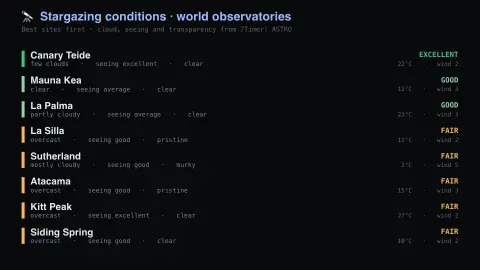
The Stargazing Forecast screensaver shows observing conditions at major world observatories from the key-less 7Timer! ASTRO model. Cloud, seeing and transparency are translated into the words an observer would use, best sites first. It's free, runs in your browser, and ESC exits.
Live preview
Press ESC to leave fullscreen. Settings are saved in your browser only.
How the Stargazing Forecast screensaver works
The background pipeline reads this from the 7Timer! ASTRO model and saves a snapshot the saver loads.
Observing conditions at major world observatories from the key-less 7Timer! ASTRO model.
It refreshes on a schedule, so what you see stays current.
Colours can be changed in settings; nothing is stored beyond your own browser.
What an astronomical forecast measures
7Timer! is a weather forecasting service, supported by the Shanghai Astronomical Observatory of the Chinese Academy of Sciences, and its ASTRO product is its oldest and is mainly intended for astronomy. It is derived from the NOAA/NCEP Global Forecast System and covers about three days ahead. Besides cloud cover, seeing and transparency, the API returns lifted index, 2 m temperature, 2 m relative humidity, 10 m wind speed and precipitation type. Forecasts are refreshed four times a day.
Seeing describes how steady the atmosphere is: turbulence makes stars twinkle and blurs fine detail, and 7Timer! scales it in arcseconds, from under 0.5 up to over 2.5, with smaller being better. Transparency is how clear the air is, scaled in magnitudes per air mass from under 0.3 to over 1, again smaller being better. Cloud cover uses nine levels, from 1 (0 to 6 percent) to 9 (94 to 100 percent). The saver translates these codes into words an observer would use.
These are model forecasts rather than measurements from the observatory. They apply to a grid cell around each site, which smooths out local effects such as a mountain's own weather, and accuracy falls with lead time. For serious planning, observers combine such a forecast with satellite imagery and their own site experience.
A worked example
Observing conditions at major world observatories from the key-less 7Timer! ASTRO model. Cloud, seeing and transparency are translated into the words an observer would use, best sites first.
Settings & tips
- Accent and Background recolour the display.
- Run
automation/run.py astroweatherto refresh the feed. - Press ESC to leave fullscreen.
Frequently asked questions
- Is this real data?
- Yes — it comes from the 7Timer! ASTRO model and is refreshed on a schedule.
- Is a key needed?
- No. This source is fully key-less.
- Is it free?
- Yes — free, no download, in your browser.
- What is seeing?
- It is a measure of atmospheric steadiness. 7Timer! gives it as an angular size in arcseconds, and smaller values mean steadier air and sharper telescope images.
- What is transparency?
- How clear the air is, affected by haze, dust and thin cloud. 7Timer! scales it in magnitudes per air mass, with smaller values meaning clearer air, which matters for faint objects such as galaxies.
- Is this measured at the observatory?
- No. It comes from a global weather model, so it can miss local conditions at the actual site.