Meteor Shower Screensaver
The Meteor Shower screensaver counts down to the next major shower's peak and rains shooting stars from the radiant at the shower's expected rate, from a built-in calendar. It's computed on your device, runs in your browser, and ESC exits.
Live preview
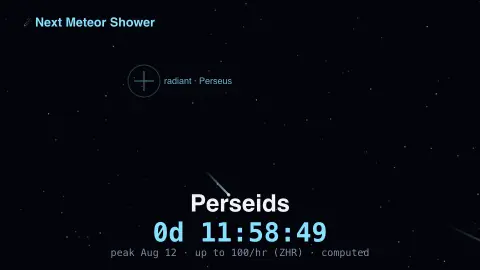
Press ESC to leave fullscreen. Settings are saved in your browser only.
How the Meteor Shower screensaver works
The saver holds a calendar of the year's major meteor showers — the Perseids, Geminids, Quadrantids and more — with each one's peak date and expected rate.
It works out the next shower to peak and counts down to it in days, hours, minutes and seconds.
Shooting stars streak from the shower's radiant across a starfield, and the spawn rate rises as the peak approaches.
Everything is computed locally, so it needs no connection.
Why meteor showers peak on schedule
Most meteor showers come from comets. As a comet travels around the Sun it sheds dust and small grains along its orbit, and when Earth crosses that trail each year the particles strike the upper atmosphere at tens of kilometres per second and burn up as meteors. The Perseids, for example, come from comet Swift-Tuttle, while the Geminids are linked to the asteroid (3200) Phaethon.
Because Earth reaches the same point of its orbit on nearly the same date each year, peaks recur on a stable calendar. The International Meteor Organization publishes an annual calendar built on a working list of visual showers, giving activity dates, peak, radiant position and zenithal hourly rate. The radiant is the spot in the sky from which the meteors seem to diverge, and showers are usually named after a nearby star or constellation.
What you see on a given night depends on more than the date. The Moon’s phase can wash out fainter meteors, the radiant needs to be above your horizon, and a dark sky away from city lights matters most. The zenithal hourly rate is a calculated maximum for an ideal observer under perfectly clear skies with the radiant overhead, so real counts are usually lower.
A worked example
In early August it counts down to the Perseids — up to 100 meteors an hour — streaks flying from a radiant high in Perseus, the rain thickening as the peak date closes in over the next few days.
Settings & tips
- Mark the radiant toggles the radiant crosshair.
- Background sets the night-sky backdrop.
- Meteors fall faster as the shower's peak nears.
Frequently asked questions
- Are the shower dates real?
- Yes. They come from the established annual meteor-shower calendar, so each peak date and rate is accurate.
- What is ZHR?
- Zenithal Hourly Rate — the number of meteors an ideal observer would see per hour at the peak under dark skies.
- What is the radiant?
- The point in the sky the meteors appear to stream from — each shower is named for the constellation its radiant sits in.
- Does it need a connection?
- No. The calendar and the falling stars are computed on your device, so it runs fully offline.
- Is it free?
- Yes — free, no download, no key, in your browser.
- Why do meteors seem to come from one point?
- The particles travel in nearly parallel paths, and perspective makes them appear to diverge from a distant radiant, the same way railway lines seem to meet on the horizon.
- Which showers come from comets?
- The Perseids come from comet Swift-Tuttle, and the Orionids and Eta Aquariids are linked to Halley’s Comet. The Geminids are linked to the asteroid (3200) Phaethon.
- When is the best time to watch?
- Usually after midnight, when your side of Earth turns to face forward into its orbital motion, ideally with the radiant high and the Moon down or faint.