Aurora Oval Screensaver
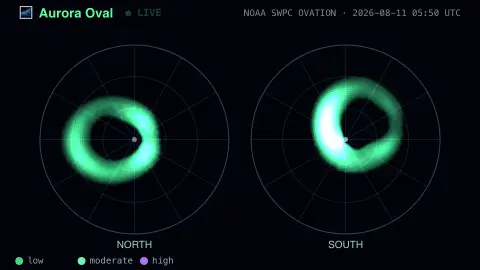
The Aurora Oval screensaver shows polar-projection maps of the northern and southern auroral ovals, where the aurora is most likely right now, from NOAA's live OVATION model. It's free, runs in your browser, and ESC exits.
Live preview
Press ESC to leave fullscreen. Settings are saved in your browser only.
How the Aurora Oval screensaver works
The saver reads NOAA's live OVATION aurora model, which forecasts the chance of visible aurora across the globe.
It draws the data as polar maps looking straight down on the north and south poles, so the auroral oval appears as a glowing ring.
Brighter, greener and violet patches mark where the aurora is strongest right now.
Show one pole or both; it refreshes every few minutes as the oval shifts.
What the OVATION aurora model predicts
The aurora happens when charged particles from the solar wind, guided by Earth’s magnetic field, strike gases high in the atmosphere near the poles and make them glow. It typically forms a ring called the auroral oval around each magnetic pole, wider and brighter when geomagnetic activity is high. The oval is centred on the magnetic pole, not the geographic pole.
OVATION was created by Patrick Newell and colleagues at the Johns Hopkins University Applied Physics Laboratory. NOAA’s Space Weather Prediction Center runs a real-time version, with OVATION 2020 operational since 2020. It takes solar wind speed and the interplanetary magnetic field measured at the L1 point, about 1.6 million kilometres upstream of Earth, and calculates electron and proton precipitation that correlates with aurora, mapped separately for the northern and southern hemispheres. NOAA describes the forecast as covering 30 to 90 minutes, the time the solar wind takes to reach Earth, and it falls back on the Kp index when solar wind data are missing.
The viewing probability NOAA shows is derived by assuming a linear relationship to aurora intensity, so it is not a direct percentage chance. A high value means conditions are favourable, not that the aurora is visible from a given spot, which also needs darkness, clear skies and a view of the horizon.
A worked example
During a geomagnetic storm the northern ring flares green and violet down over Canada and Scandinavia, the southern oval glowing over the deep Southern Ocean — both pulsing as the OVATION model updates.
Settings & tips
- Hemisphere shows the north pole, south pole, or both.
- Background sets the space backdrop.
- Greener and violet patches mark stronger aurora.
Frequently asked questions
- Is the forecast live?
- Yes. It comes from NOAA's OVATION aurora model and refreshes every few minutes, so the ovals reflect current conditions.
- How is this different from Space Weather?
- Space Weather maps the aurora on a flat globe with a Kp gauge; Aurora Oval gives the dedicated polar view of each oval.
- What do the colours mean?
- They show aurora intensity — green for moderate activity, shading to violet where the model predicts the strongest displays.
- Does it need a key?
- No. NOAA's space-weather data is free and key-less; the saver only needs an internet connection.
- Is it free?
- Yes — free, no download, in your browser.
- Why does the oval seem to shift with the time of day?
- The magnetic pole sits away from the geographic pole, so as Earth rotates a fixed place moves closer to or further from the oval. The map is a snapshot of one moment.
- Can I see the aurora if my location is outside the oval?
- During strong geomagnetic storms the oval expands toward the equator and the lights can be seen from much lower latitudes. NOAA rates such storms on its G-scale.
- What is the difference between magnetic and geographic poles?
- The geographic poles mark Earth’s rotation axis, while the magnetic poles are set by Earth’s magnetic field and drift over time. The aurora is organised around the magnetic poles.