Solar Cycle Screensaver
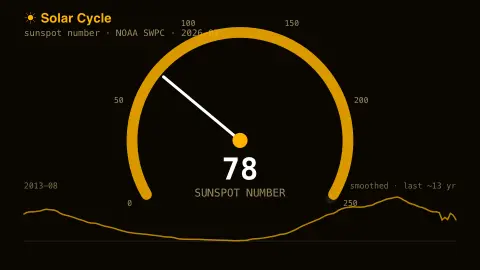
The Solar Cycle screensaver is a dial of the Sun's current sunspot number set against the 11-year solar cycle, with the rise and fall of recent years traced beneath, from NOAA SWPC. It's free, runs in your browser, and ESC exits.
Live preview
Press ESC to leave fullscreen. Settings are saved in your browser only.
How the Solar Cycle Dial screensaver works
The saver reads NOAA SWPC's observed solar-cycle indices — the monthly sunspot number that tracks the Sun's activity.
It shows the latest value on a gauge whose needle eases from a quiet zero toward a busy solar maximum.
Beneath the dial, a sparkline traces the rise and fall of the sunspot number over the last several years.
It refreshes a few times a day as new monthly figures are published.
What the sunspot number actually counts
Sunspots are darker, cooler patches on the Sun caused by concentrated magnetic flux that inhibits convection. Thomas Harriot first observed them through a telescope in December 1610. Their number rises and falls over a cycle that averages about 11 years from one minimum to the next, though cycles have ranged from about 9 to 14 years. Rudolf Wolf numbered the cycles in the 1850s and designated the first as starting in February 1755; Cycle 25 began in December 2019.
The sunspot number is not a plain count. In its classic form, R = k(10g + s), it combines the number of individual spots (s) with ten times the number of spot groups (g), scaled by an observer factor k. The international series is produced at the Royal Observatory of Belgium, where SILSO is the World Data Center for the sunspot number. A revised series released on 1 July 2015 recalibrated the whole historical record, so older published values differ from current ones.
A 13-month smoothed mean is used to find cycle minima and maxima, because it damps sudden jumps and removes the effect of the 27-day solar rotation. The number is a coarse proxy for solar activity, so a quiet-looking cycle can still contain big events, and the next peak can only be forecast with considerable error. The data shown describes what has been observed.
A worked example
Near solar maximum the needle swings high — a sunspot number well over 100 — the sparkline beneath climbing steeply through recent years, a clear picture of where the Sun sits in its eleven-year heartbeat.
Settings & tips
- Accent recolours the dial and trace.
- Background sets the panel backdrop.
- The sparkline shows roughly the last thirteen years.
Frequently asked questions
- Is the data live?
- Yes. It uses NOAA SWPC's observed solar-cycle indices, refreshed a few times a day, so the dial shows the latest sunspot number.
- What is the sunspot number?
- A count of sunspots and groups on the Sun — a long-running measure of solar activity that rises and falls every eleven years.
- What is the solar cycle?
- The Sun's roughly eleven-year cycle between quiet minimum and active maximum, driven by its churning magnetic field.
- Does it need a key?
- No. NOAA's space-weather data is free and key-less; the saver only needs an internet connection.
- Is it free?
- Yes — free, no download, in your browser.
- How long is the solar cycle?
- On average about 11 years from one minimum to the next, but cycles have ranged from about 9 to 14 years. The magnetic polarity returns to its original state after two cycles, a span of about 22 years.
- Why does the monthly value look smooth?
- A common smoothed series is a 13-month mean that damps sudden jumps. Because it needs months on either side, the most recent smoothed points are not final.
- Who maintains the sunspot number?
- The international series is produced at the Royal Observatory of Belgium, through its SILSO centre. It was recalibrated in a revision released on 1 July 2015.