Exoplanet Feed Screensaver
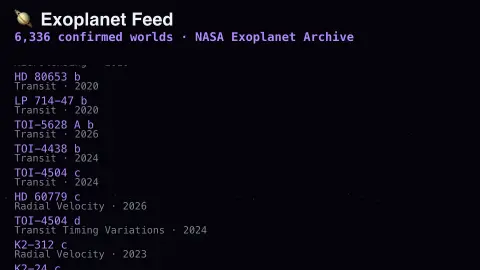
The Exoplanet Feed screensaver scrolls through the most recently confirmed exoplanets — name, host star and discovery method — drawn key-less and live from NASA's official Exoplanet Archive. It's free, runs in your browser, and ESC exits.
Live preview
Press ESC to leave fullscreen. Settings are saved in your browser only.
How the Exoplanet Feed screensaver works
The saver queries NASA's Exoplanet Archive for the most recently confirmed planets, with no key required.
Each world scrolls through with its designation, host star and how it was discovered.
A running total shows how many confirmed exoplanets are now known — a real, ever-growing number.
The feed refreshes periodically as newly confirmed worlds are added to the archive.
How a planet becomes confirmed in the NASA archive
The NASA Exoplanet Archive is an online catalogue and data service for planets around other stars, run by the NASA Exoplanet Science Institute (NExScI) at Caltech’s IPAC under contract with NASA. Its team monitors the literature for relevant planet publications, and the original references are given for the data.
To be listed as a planet, an object must meet the archive’s criteria: a mass, or minimum mass, no more than 30 Jupiter masses; orbiting a star rather than free-floating; enough follow-up and validation to make a false positive unlikely; and properties published in the peer-reviewed literature.
The discovery method is a key field, because each technique sees a different kind of planet. Transit searches look for the dip in starlight when a planet crosses its star, radial velocity measures the wobble the planet induces, and direct imaging photographs large, young, distant worlds. Microlensing uses the brief brightening when a planet’s gravity bends the light of a background star. The mix therefore says as much about instruments as about the galaxy. Where a planet was announced more than once, the archive lists the first accepted paper as the discovery paper, so the year shown is a publication year rather than the date the row was added.
A worked example
You might see TOI-4527 b scroll past, discovered by the transit method around a distant star — a real, recently confirmed planet straight from NASA's own archive.
Settings & tips
- Discovery method toggles whether the detection technique is shown.
- Accent recolours the planet glyphs.
- The confirmed-count is real and climbs over time as new discoveries are published.
Frequently asked questions
- Are these confirmed, not just candidates?
- Yes — the feed pulls confirmed planets from NASA's Exoplanet Archive, not unconfirmed candidate detections.
- Is a key needed?
- No. NASA's Exoplanet Archive is free and key-less.
- How many exoplanets are known?
- The running total reflects the real, current confirmed count — well over five thousand and rising.
- Is it free?
- Yes — free, no download, in your browser.
- What does the archive require before listing a planet?
- A mass or minimum mass of no more than 30 Jupiter masses, an orbit around a star, validation that makes a false positive unlikely, and properties published in the peer-reviewed literature.
- Who runs the NASA Exoplanet Archive?
- It is operated by Caltech under contract with NASA, through the NASA Exoplanet Science Institute (NExScI) at Caltech’s IPAC in Pasadena.
- Is the discovery year the date a planet was found?
- No. It follows the first accepted discovery paper, so it reflects publication rather than when the signal was first observed.