Total Solar Eclipse Path Tracker Screensaver
The Total Solar Eclipse Path Tracker screensaver counts down to the next real total solar eclipse, with its real published path and date. It is free, runs in your browser, and ESC exits.
Live preview
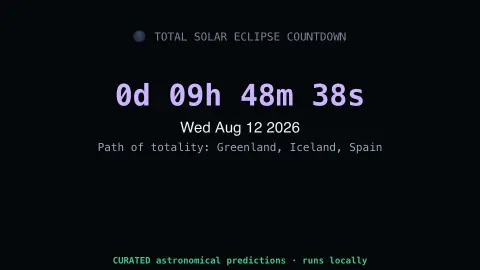
Press ESC to leave fullscreen. Settings are saved in your browser only.
How the Total Solar Eclipse Path Tracker screensaver works
The saver looks up the next real total solar eclipse date from a pre-loaded table of published astronomical predictions.
A live countdown ticks down to that real date, alongside the real regions the path of totality will cross.
Once passed, the saver automatically advances to the next real total eclipse on the table.
The computation runs entirely in your browser — no network fetch is needed.
Why total eclipses are rare in any one place
A total solar eclipse happens when the Moon passes directly between the Sun and Earth and its dark central shadow, the umbra, sweeps across the surface. The umbra is narrow: NASA gives the path of totality as at most about 167 miles (roughly 270 km) wide, and usually under 150 miles, so it is a thin ribbon. Outside it, observers see only a partial eclipse, in which the Sun is covered in part. Totality can last up to about 7.5 minutes at its longest, and is usually much shorter.
Eclipses are predictable far into the future because the motions of the Earth and Moon are well understood. Eclipses recur with very similar duration and path every 6,585.3 days, about 18 years, 11 days and 8 hours, a period known as the saros. The extra 8 hours means each eclipse in a series falls about a third of the way further around the globe. After three saros cycles, 54 years and 33 days, an eclipse returns to nearly the same geographic area.
Paths published in advance by organisations such as NASA are calculated to a high accuracy. For safety, the partial phases are never safe to look at without proper solar filters, even when 99 percent of the Sun is covered. Only the brief total phase, once the Moon completely covers the Sun, is safe to watch with the naked eye.
A worked example
As the countdown reaches the real eclipse date, the display automatically advances to count down toward the next real total solar eclipse.
Settings & tips
- Accent recolours the countdown digits.
- Dates and paths are from real published astronomical eclipse predictions.
- No internet connection is required — the lookup runs locally.
Frequently asked questions
- Is this a real countdown?
- Yes — it counts down to real, published total solar eclipse dates.
- Is a key needed?
- No — it uses a local, pre-loaded real astronomical table.
- How are eclipse paths predicted?
- Real orbital mechanics allow eclipse paths to be predicted precisely, decades in advance.
- Is it free?
- Yes — free, no download, in your browser.
- What is the saros?
- A cycle of about 18 years, 11 days and 8 hours after which the Sun, Earth and Moon return to almost the same geometry, so similar eclipses recur, shifted around the globe.
- Why can you see only a partial eclipse outside the path?
- Only the Moon's small umbral shadow produces totality, and places outside the narrow path see the Sun only partly covered.
- Is it safe to look at the Sun during totality?
- Only during the brief total phase, when the Sun is completely covered. Before and after, solar filters made for the purpose are needed, or a projection method.