Fireball Map Screensaver
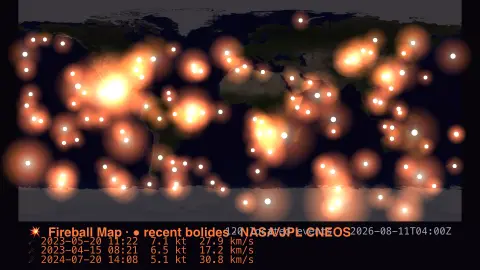
The Fireball Map screensaver flashes recent fireballs — bright meteors that blaze in the upper atmosphere — on a world map, sized by energy, from NASA/JPL's fireball data via the pipeline. It's free, runs in your browser, and ESC exits.
Live preview
Press ESC to leave fullscreen. Settings are saved in your browser only.
How the Fireball Map screensaver works
A background pipeline reads NASA/JPL's catalogue of recent fireballs — bolides bright enough to be detected as they burn up in the atmosphere.
The saver plots each one on a world map at the spot it was seen, flashing it with a glow sized by its released energy.
The biggest, most energetic events flare largest, so major bolides stand out across the globe.
The most energetic recent events are listed below, and it refreshes periodically.
Fireballs, bolides and satellite detection
NASA’s Center for Near-Earth Object Studies (CNEOS) publishes a public table of fireball events. Its data are derived from U.S. Government sensor detections, and CNEOS does not independently verify or reanalyse them. A fireball is an exceptionally bright meteor, and fireballs that explode in the atmosphere are technically called bolides, though the two terms are often used interchangeably.
Each entry gives the date and time of peak brightness and, when reported, a latitude and longitude, an altitude in kilometres and the entry velocity components in kilometres per second. Two energy figures are listed: the total radiated energy in joules, and a calculated total impact energy in kilotons of TNT, derived from an empirical relation to the radiated energy. A kiloton of TNT is a unit of energy, about 4.2 trillion joules, not a statement that something exploded like a bomb.
The table is not a complete count of every fireball. CNEOS states that the data are not provided in real time and that not all fireballs are reported, and blank fields simply mean a value was not reported. Detections from the GOES satellites’ Geostationary Lightning Mapper are listed separately on a different site.
A worked example
A flash blooms over the Pacific where a bolide released several kilotonnes of energy, smaller sparks dotting other oceans and continents — the recent list reading dates, energies and entry speeds like 18.4 km/s.
Settings & tips
- Accent recolours the fireball flashes.
- Background sets the map backdrop.
- Run
automation/run.py fireballson your pipeline machine to refresh events.
Frequently asked questions
- Is the data real?
- Yes. It comes from NASA/JPL's CNEOS fireball catalogue, gathered by the pipeline, so every flash is a recorded event.
- What is a fireball?
- A fireball, or bolide, is an unusually bright meteor — a chunk of space rock blazing as it enters the atmosphere.
- Why does it use a pipeline?
- The NASA fireball API is locked to its own origin in the browser, so a background script reads it and saves a snapshot.
- Why are some events over the ocean?
- Most of Earth is water, so many fireballs are detected over open ocean by sensors rather than eyewitnesses.
- Is it free?
- Yes — free, no download, in your browser.
- Why do some entries lack speed or altitude?
- Those values are given only when they were reported. A blank field means the value was not reported, not that it was zero.
- Does this list every fireball on Earth?
- No. CNEOS says not all fireballs are reported and the data are not provided in real time, so fireballs seen only by people or camera networks may not appear.
- What does kilotons of TNT mean for a meteor?
- It is just a convenient energy scale. One kiloton of TNT is defined as about 4.2 trillion joules, and CNEOS calculates the impact energy from the radiated energy using an empirical relation.