Asteroid Close-Approach Clock Screensaver
The Asteroid Close-Approach Clock counts down to the next near-Earth asteroid flyby from NASA/JPL's close-approach database — the rock's name, miss distance in lunar distances, speed and size range, with the next three approaches queued below. It's free, needs an internet connection, and ESC exits.
Live preview
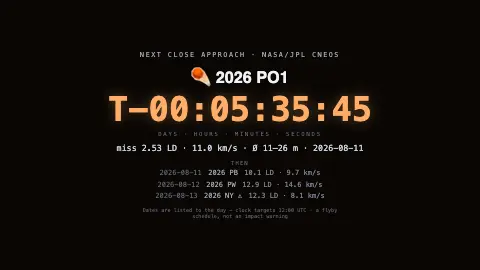
Press ESC to leave fullscreen. Settings are saved in your browser only.
How the Asteroid Close-Approach Clock screensaver works
The site's pipeline gathers upcoming close approaches from NASA/JPL's CNEOS database into content/asteroids.json; the saver re-reads it every hour.
It picks the next approach still in the future and runs a T-minus clock — days, hours, minutes, seconds — ticking four times a second.
The feed lists approach dates to the day, so the clock targets 12:00 UTC on the listed date; the footnote on screen says so.
A ⚠ badge marks rocks NASA classes as potentially hazardous — a size-and-orbit category, not an impact warning; every listed approach is a safe miss.
How near-Earth asteroids get tracked
Near-Earth objects are asteroids and comets with a perihelion distance under 1.3 astronomical units, so their orbits can bring them close to Earth. NASA's Center for Near Earth Object Studies (CNEOS), hosted by JPL, publishes a close-approach table covering 1900 to 2200 that lists only encounters with reasonably low uncertainty. Each approach time carries a 3-sigma uncertainty, so a predicted date and distance are calculated estimates that can shift as more observations are made.
Distances are given in lunar distances, where one is the Moon's mean distance from Earth, about 384,400 kilometres. A flyby at several lunar distances is a safe miss in astronomical terms. Sizes are estimated from absolute magnitude H, with a range worked out using albedos of 0.25 and 0.05, so a smaller H means a larger asteroid and the result is a range rather than one figure.
CNEOS defines a potentially hazardous asteroid as a near-Earth asteroid with a minimum orbit intersection distance from Earth's orbit of 0.05 au (roughly 7.48 million kilometres) or less and an absolute magnitude of 22.0 or brighter, which corresponds to roughly 140 metres across at a 14 percent albedo. It is a screening category, not an impact warning.
A worked example
With 2025 AL2 up next, the screen reads T−21:03:44:09 under its name and ⚠ badge, with the stats line miss 2.19 LD · 12.4 km/s · Ø 75–168 m and three later flybys queued below. Pair it with the Asteroid Watch radar in Multi-view — the radar shows the whole field while this clock counts down the single next event.
Settings & tips
- Show upcoming queue — turn the three-row list of following approaches off for a cleaner, countdown-only screen in small Multi-view cells.
Frequently asked questions
- Is this real asteroid data?
- Yes. The approaches come from NASA/JPL's Center for Near-Earth Object Studies close-approach database, gathered by the site's pipeline and refreshed on a schedule. The countdown itself ticks live in your browser.
- Does the ⚠ badge mean an asteroid will hit Earth?
- No. "Potentially hazardous" is NASA's classification for objects over roughly 140 m that can come within 19.5 lunar distances — it describes size and orbit, not a predicted impact. Every approach shown is a miss.
- How is this different from the Asteroid Watch saver?
- Asteroid Watch is a radar scope plotting all upcoming approaches at once. This saver is the clock view: one big countdown to the very next flyby, with the following three queued.
- Does it need an API key or work offline?
- No key — the pipeline reads NASA's public data. It does need an internet connection to load the feed; if the feed is missing it tells you exactly which pipeline flag to run.
- Is it free?
- Yes — free, no download, in your browser. ESC exits at any time.
- What is a lunar distance?
- It is the Moon's mean distance from Earth, about 384,400 kilometres. Astronomers use it as an intuitive yardstick for near passes.
- What makes an asteroid potentially hazardous?
- Two criteria: an orbit that comes within 0.05 au (about 7.48 million kilometres) of Earth's orbit, and an absolute magnitude of 22.0 or brighter, roughly 140 metres or larger. It describes the orbit and size, not a predicted impact.
- Why are sizes given as a range?
- Size is estimated from absolute magnitude, and the same brightness fits a larger dark object or a smaller reflective one. CNEOS gives a range using albedos of 0.25 and 0.05.