Programming Language Popularity Board Screensaver
The Programming Language Popularity Board screensaver ranks programming languages by real reported usage, from a published annual developer survey. It is free, runs in your browser, and ESC exits.
Live preview
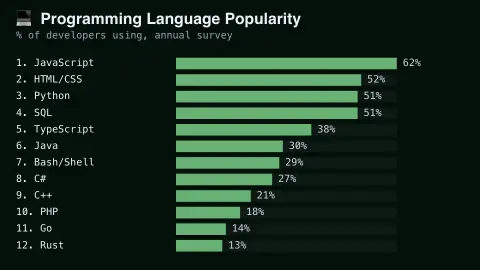
Press ESC to leave fullscreen. Settings are saved in your browser only.
How the Programming Language Popularity Board screensaver works
The saver displays a real, curated ranking of programming languages by their reported real usage share.
Each language shows its real published rank and usage percentage.
The board refreshes periodically as new real annual survey results are published.
No live feed is required — figures are a real, curated periodic snapshot.
How programming language rankings are built
Programming language rankings come from different kinds of evidence, and the method shapes the result. The TIOBE index counts search-engine hits for the query of a language name followed by the word programming, across a set of search engines. The RedMonk ranking combines GitHub pull-request counts with Stack Overflow data, and the Stack Overflow Developer Survey polls developers directly about what they use.
This board shows each language's published rank and a usage percentage, so the number means whatever the source's methodology says, usually a share of searches, mentions or respondents. A language can be popular because it is taught widely, because it dominates a niche such as data science or embedded systems, or because older codebases still need maintenance.
Rankings measure attention or reported use, not quality, performance or suitability for a project. Survey samples skew toward people who answer surveys, and search-based indexes are affected by how ambiguous a language's name is. TIOBE, for instance, applies a confidence factor to discount false-positive hits. Small movements between neighbours are often within the noise, so only long-term trends are meaningful.
A worked example
A rapidly growing real language climbs the board year over year, exactly matching its rise in the published survey's real results.
Settings & tips
- Accent recolours the ranking bars.
- Rankings reflect a real, published developer survey, not a single source's opinion.
- The board updates once each real survey cycle.
Frequently asked questions
- Is this a real published ranking?
- Yes — from a real, well-known annual developer survey and usage report.
- Is a key needed?
- No — figures are a curated real periodic snapshot.
- How often does it change?
- Once each real survey cycle, typically annually.
- Is it free?
- Yes — free, no download, in your browser.
- Does a higher rank mean a better language?
- No. Rankings reflect how often a language is searched for, used or reported, which is a different thing from design quality or fitness for a task.
- Why do different rankings disagree?
- They measure different things, such as search hits, pull requests on GitHub, Stack Overflow activity or survey answers, and each has its own sampling biases.
- Why does a language with few users still rank?
- Rankings are relative. A language can sit high because of heavy use in a particular sector, even when it is rarely used outside it.