Global IPv6 Adoption Screensaver
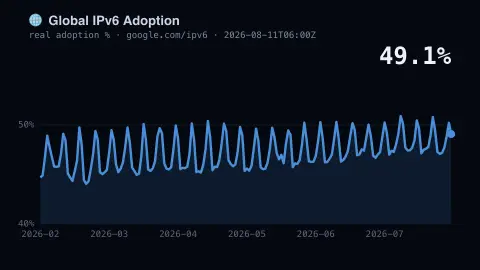
The Global IPv6 Adoption screensaver charts real global IPv6 adoption percentage over time, from Google's own published statistics. It is free, runs in your browser, and ESC exits.
Live preview
Press ESC to leave fullscreen. Settings are saved in your browser only.
How the Global IPv6 Adoption screensaver works
The saver reads Google's own real published daily IPv6 adoption percentage data file.
The line chart plots real adoption percentage across the available real time span.
The pipeline refreshes the series regularly as Google updates its data.
No key is required for this key-less public endpoint.
Counting the shift from IPv4 to IPv6
Every device on the internet needs an address, and the original scheme, IPv4, uses 32-bit numbers, which allow about 4.3 billion unique addresses. The pool ran short as the network grew: on 3 February 2011 the IANA allocated its last free blocks to the five regional internet registries. IPv6, specified by the IETF in the late 1990s, uses 128-bit addresses, about 340 undecillion of them, a space so large that scarcity effectively disappears.
The two versions are not directly compatible, so networks run them side by side and client software chooses which to use for each connection. Google measures adoption from its own side: it continuously measures the availability of IPv6 connectivity among its users, and the chart shows the share who reach Google over IPv6. A rising line means more users have working IPv6 connectivity at home, on mobile networks or at work.
Because the measure is based on Google’s users, it is a sample, not a census of every network, and regional adoption differs widely. Day-to-day wobble should not be mistaken for a trend, so the longer shape of the line says more than any single day.
A worked example
The real chart shows global IPv6 adoption climbing from single digits years ago to its real current percentage today.
Settings & tips
- The percentage reflects Google's own real measured share of IPv6 traffic to its services.
- Accent recolours the chart line.
- Data spans real daily measurements back to 2008.
Frequently asked questions
- Is this real internet data?
- Yes — real adoption statistics published by Google.
- Is a key needed?
- No. Google's statistics data file is fully key-less.
- Does this cover the whole internet?
- It reflects Google's own real measured traffic share, a widely-cited proxy for global adoption.
- Is it free?
- Yes — free, no download, in your browser.
- Why did we run out of IPv4 addresses?
- The 32-bit address space allows only about 4.3 billion addresses. It was designed when the internet was small, and the growth in phones, computers and servers eventually exhausted the pool of free blocks.
- Can IPv4 and IPv6 work together?
- Yes, side by side. They are not directly compatible, but most networks and devices can run both, and software chooses which to use for a connection, so users rarely notice which one carries their traffic.
- Why does the line zigzag?
- Daily figures are noisy, because the mix of users and networks being measured shifts from day to day, so the longer trend matters more than single points.