Docker Hub Pull Trends Screensaver
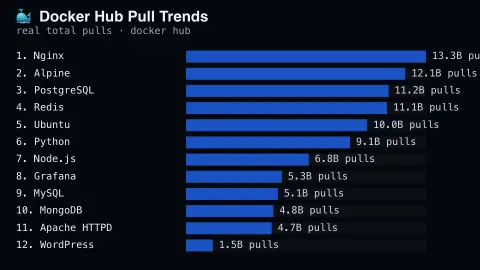
The Docker Hub Pull Trends screensaver ranks major container images by their real cumulative pull count from Docker Hub. It is free, runs in your browser, and ESC exits.
Live preview
Press ESC to leave fullscreen. Settings are saved in your browser only.
How the Docker Hub Pull Trends screensaver works
The saver reads real pull-count and star-count totals for a curated list of images from Docker Hub's API.
Images are ranked by their real reported pull count, highest first.
The pipeline refreshes the board on its own schedule.
No key is required for this key-less public endpoint.
What a Docker pull count measures
Docker Hub is a public registry for container images: packaged applications and base systems that run the same way on any machine with a container runtime. Docker Official Images are a curated set of repositories hosted on Docker Hub, including base images such as Ubuntu, Alpine, Python, Node and MySQL, and Docker recommends them for most projects.
A pull is a download request for an image. Builds on developer laptops, continuous-integration pipelines and production servers can all pull the same image, so one team can generate a great many pulls, and a count of pulls is not a count of people. Organisations that run their own mirror or cache may pull from Docker Hub less often than their number of users would suggest.
The saver reads pull-count and star-count totals for a curated list of images. The pull count is cumulative, so older projects have a head start, and it says nothing about the number of distinct users or the quality of the image. Stars are a lighter signal, given by individuals who bookmark a repository. Treat the ranking as a view of how widely popular infrastructure is fetched, not an endorsement.
A worked example
An official image with a real pull count in the billions sits at the top of the ranked board, exactly matching Docker Hub's own figure.
Settings & tips
- Pull counts are real cumulative totals, not per-day download rates.
- Accent recolours the ranking bars.
- The image list is curated, not the full Docker Hub catalog.
Frequently asked questions
- Is this real Docker data?
- Yes — real pull counts from the Docker Hub public API.
- Is a key needed?
- No. Docker Hub's public repository metadata is key-less.
- Does this update every second?
- No — pull counts update on the pipeline's own refresh schedule.
- Is it free?
- Yes — free, no download, in your browser.
- Does a pull count equal the number of users?
- No. Automated builds and servers pull the same image repeatedly, so one team can generate a great many pulls.
- What are official images?
- Docker Official Images are a curated set of repositories on Docker Hub, including base images such as Ubuntu, Alpine, Python, Node and MySQL.
- Why are older images higher in the ranking?
- The pull count is cumulative, so projects with a longer history have had more time to accumulate pulls.