Planetarium Screensaver
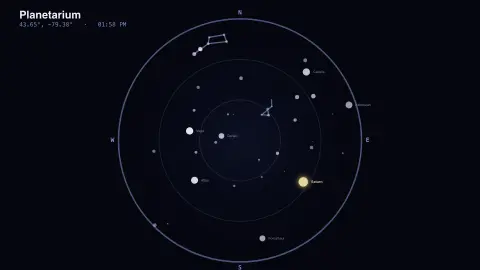
The Planetarium screensaver is a live star map of the night sky above you right now, showing constellations, the brightest stars and the visible planets. It is computed on your device from the current date and time, needs no data feed, runs in your browser, and ESC exits.
Live preview
Press ESC to leave fullscreen. Settings are saved in your browser only.
How the Planetarium screensaver works
The saver reads your device clock and chosen location, then computes the local sidereal time — the celestial coordinate that tells it which way the sky is turned.
A built-in catalogue of the brightest stars is projected onto a circular sky dome; only stars currently above your horizon are drawn, sized by their magnitude.
The visible planets are placed using the same orbital math as the Orrery, reduced to where they sit in your sky tonight.
Constellation figures and the N/E/S/W horizon are drawn so you can orient yourself, and it all turns slowly as the real sky does.
Why the sky depends on place and time
The stars seem to wheel across the night sky because the Earth rotates once in just under 24 hours. From any spot, the part of the sky you can see depends on your latitude and on the sidereal time, which tracks how far the Earth has turned relative to the distant stars rather than the sun. Sidereal time gets ahead of clock time by roughly four minutes a day, which is why constellations rise earlier as the months pass.
A star map turns that geometry into a picture by converting each star's fixed coordinates, right ascension and declination, into altitude and azimuth, the angle above the horizon and the compass direction, for the observer's location. Stars barely move relative to one another over a human lifetime, so a catalogue of the brightest ones stays valid for centuries. Planets, in contrast, wander against that background, so their positions have to be calculated from their orbits for the date.
Real skies differ from a map in several ways. Light pollution and moonlight hide fainter stars, and cloud and haze block more. Venus and Jupiter at their best are brighter than any star. The brightness scale is magnitude, in which smaller or negative numbers are brighter, and the naked eye in dark conditions reaches roughly magnitude six. The constellation lines are a human convention for finding patterns, not physical connections.
A worked example
Pick a location and the dome fills with the stars actually overhead — Vega high up, Orion tracing its belt, a bright planet labelled near the horizon. By day it notes the sky is too bright to see them, but still shows where everything is.
Settings & tips
- Location sets the observer's latitude and longitude, which decides what's above the horizon.
- Star & planet labels toggles the names on and off.
- Constellation lines recolours the joined-up figures.
Frequently asked questions
- Is this the real sky right now?
- Yes. It's computed live from your clock and location, so the stars and planets are placed where they really are in your sky at this moment.
- Does it need an internet connection?
- No. All the astronomy is calculated on your device from a built-in star catalogue, so it runs fully offline.
- Why can't I see many stars?
- If your location is in daylight the saver notes the sky is too bright. It also shows only the brightest stars, the ones you'd actually pick out by eye.
- How accurate is it?
- Star and planet positions are accurate to within a fraction of a degree — perfect for finding constellations, though not an observatory-grade ephemeris.
- Is it free?
- Yes — free, no download, no key, entirely in your browser.
- Why do the constellations change with the seasons?
- As Earth orbits the sun, the night side faces a different part of the sky through the year. Constellations in the direction of the sun are lost in daylight.
- Why do planets not appear in star catalogues?
- Planets move against the fixed stars on orbits of months to years, so their positions have to be recalculated for each date, while a star's coordinates are effectively constant.
- Is the Moon part of the map?
- A sky map can show it, but it is a small and fast-moving object whose position and phase must be computed separately. Moonlight is also the main reason faint stars vanish on bright nights.