Asteroid Watch Screensaver
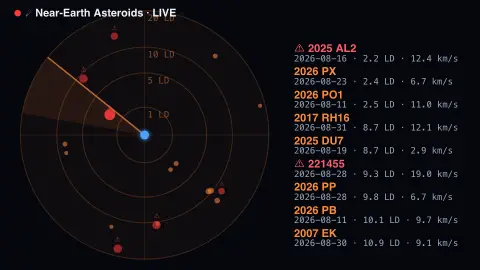
The Asteroid Watch screensaver is a radar scope of near-Earth asteroids making their closest approaches over the coming days, with their miss distances and speeds, from NASA/JPL's key-less close-approach database via the pipeline. It's free, runs in your browser, and ESC exits.
Live preview
Press ESC to leave fullscreen. Settings are saved in your browser only.
How the Asteroid Watch screensaver works
A background pipeline queries NASA/JPL's close-approach database — the public catalogue of asteroids passing near Earth — and saves the upcoming approaches.
The saver draws a radar scope with Earth at the centre and range rings measured in lunar distances (the Earth-Moon gap).
Each asteroid is plotted at a radius set by its real miss distance and sized by its estimated diameter, with a sweeping radar line pinging across them.
A list reads off the next approaches with their date, miss distance and speed; potentially hazardous ones are flagged.
Close approaches and how they are catalogued
The data come from the Center for Near Earth Object Studies (CNEOS) at NASA's Jet Propulsion Laboratory, which tracks near-Earth objects, asteroids and comets whose orbits bring them within 1.3 au of the Sun at closest approach, and predicts when they pass close to Earth. Because small asteroids are faint, they are detectable only when they are near, so the listing contains many objects far smaller than the ones that make news.
Miss distance is given in lunar distances, the average gap between Earth and the Moon, so a pass at one lunar distance is as far from us as the Moon. The diameter shown is an estimate rather than a measurement: it is derived from the object's absolute magnitude (a brightness measure) and an assumed albedo, or reflectivity, so a dark rock and a bright one of the same brightness would differ in size. Speed is the velocity relative to Earth, in kilometres per second.
The label potentially hazardous asteroid has a fixed definition: an Earth minimum orbit intersection distance of 0.05 au or less (roughly 7.5 million km) and an absolute magnitude of 22.0 or less, which corresponds to about 140 m across at an assumed 14% albedo. It describes an orbit and a size, not a predicted impact.
A worked example
The scope sweeps and pings on rocks like 2026 MQ2 · 1.3 LD · 11 km/s — passing closer than the Moon — while more distant asteroids sit out near the edge of the rings. Larger or closer ones glow brighter as the radar line crosses them.
Settings & tips
- Scope color recolours the radar display.
- Background sets the scope backdrop.
- Run
automation/run.py asteroidson your pipeline machine to refresh the approaches.
Frequently asked questions
- Is this real asteroid data?
- Yes. The approaches come from NASA/JPL's official close-approach database, refreshed by the pipeline, so the dates and miss distances are real.
- What is a lunar distance?
- One lunar distance (LD) is the average Earth-to-Moon gap, about 384,000 km. The rings use it so you can see which asteroids pass closer than the Moon.
- Are any of these going to hit Earth?
- No — these are catalogued safe close approaches. Ones flagged as potentially hazardous are simply larger and pass relatively near, not on a collision course.
- Why does it use a pipeline?
- JPL's database isn't readable directly from a browser, so a small background script fetches it and saves a snapshot the saver loads.
- Is it free?
- Yes — free, no download, in your browser.
- What does potentially hazardous mean?
- NASA defines a potentially hazardous asteroid as one whose orbit can come within 0.05 au of Earth's orbit and whose absolute magnitude is 22.0 or less, roughly 140 m or larger. It is a monitoring category, not a forecast of impact.
- Why are most listed asteroids so small?
- Small asteroids are faint, so they are only detectable when they pass close, and a close-approach list therefore includes many small objects that would be invisible at greater range.
- Why is the size only an estimate?
- Most asteroids are not measured directly. Their size is inferred from absolute magnitude and an assumed albedo, so the true diameter can differ from the figure shown.