DSN Now Screensaver
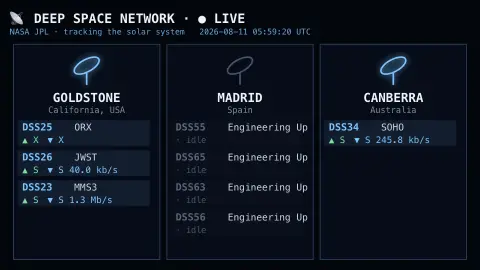
The DSN Now screensaver is a live look at NASA's Deep Space Network — which giant antenna is talking to which spacecraft right now, from Voyager to Mars orbiters — from the key-less DSN Now feed. It's free, runs in your browser, and ESC exits.
Live preview
Press ESC to leave fullscreen. Settings are saved in your browser only.
How the DSN Now screensaver works
The saver reads NASA's DSN Now feed, the live status of the Deep Space Network's giant dish antennas at Goldstone, Madrid and Canberra.
For each antenna it shows which spacecraft it's currently tracking — Voyager, Mars orbiters, deep-space probes — and whether it's sending or receiving.
Uplink and downlink indicators, the radio band and the data rate are shown the way mission controllers see them.
The feed is near-real-time, so the links shift as antennas hand off between spacecraft.
NASA's Deep Space Network and its three sites
The Deep Space Network is operated for NASA by its Jet Propulsion Laboratory, which is managed by Caltech. It is a set of large radio antennas used to communicate with spacecraft far beyond Earth orbit, with three complexes near Goldstone in California, near Madrid in Spain and near Canberra in Australia. They are placed around the globe so that, as Earth rotates, a distant spacecraft is always in view of at least one station.
DSN Now is a public status page showing which dishes are active, which spacecraft each is tracking and the signals involved. Each complex has at least four deep space terminals: three or more 34-metre beam waveguide antennas and one 70-metre antenna. Bigger dishes collect weaker signals. A single antenna can receive from several spacecraft at once, up to four at a time, though only one spacecraft can be sent an uplink at a time.
What is displayed is a snapshot of activity, not a full list of missions: the network is shared, and a spacecraft only appears while a dish is communicating with it. Because radio signals travel at the speed of light, a message to a distant probe can take many hours to arrive, so what you see reflects links in progress rather than the instantaneous state of the probe.
A worked example
You might see Canberra's 70-metre dish locked onto VGR2 (Voyager 2) on a downlink, while Madrid talks to a Mars orbiter — the antennas and their targets changing through the day as the network juggles deep-space traffic.
Settings & tips
- Accent recolours the antenna and signal highlights.
- Background sets the console backdrop.
- The three complexes are spaced around the globe so one always faces deep space.
Frequently asked questions
- Is this really live?
- Yes. It's NASA's DSN Now feed, near-real-time, so the antenna-to-spacecraft links shown are the actual ones happening now.
- What spacecraft can appear?
- Anything the Deep Space Network supports — the Voyagers, Mars orbiters and landers, deep-space observatories and interplanetary probes.
- Does it need a key?
- No. The DSN Now feed is public and key-less; the saver only needs an internet connection.
- Why do the links keep changing?
- As Earth turns and spacecraft rise and set over each complex, antennas hand off and retarget — so the board updates continuously.
- Is it free?
- Yes — free, no download, in your browser.
- Why are there three sites?
- Spacing the three complexes around the globe means that Earth's rotation always brings one of them into view of a distant spacecraft, so a spacecraft is always in view of at least one station.
- How big are the dishes?
- Each complex has one 70-metre antenna and at least three 34-metre beam waveguide antennas. Bigger dishes collect weaker signals.
- Why is the data rate sometimes tiny?
- Signal strength falls rapidly with distance, so a far-away probe with a small transmitter can only send a few bits per second, and the dish needs time to collect them.