Jupiter's Moons Screensaver
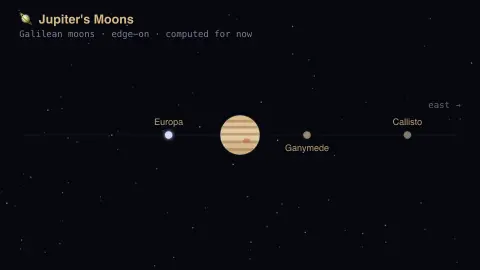
The Jupiter's Moons screensaver shows Io, Europa, Ganymede and Callisto shuttling around Jupiter exactly as a small telescope would show them tonight — all computed on your device. It's free, runs in your browser, and ESC exits.
Live preview
Press ESC to leave fullscreen. Settings are saved in your browser only.
How the Jupiter's Moons screensaver works
The saver computes each Galilean moon's position from its orbital period, projected to this exact moment.
It draws the classic edge-on view: Jupiter's banded disc in the centre with the four moons strung out along the equator.
Moons in front of Jupiter shine bright; those swinging behind dim and slip out of view, just as through a telescope.
The whole configuration matches the real sky right now, and it needs no connection.
Galileo's four moons and their 1:2:4 dance
In January 1610 Galileo pointed an early telescope at Jupiter and noticed small points of light that changed position from night to night. By mid-January he concluded that they orbited the planet. Io, Europa, Ganymede and Callisto were the first moons found around another planet, and they are still called the Galilean moons. The German astronomer Simon Marius independently observed them at about the same time.
Their orbits lie close to the plane of Jupiter's equator, which is why we see them nearly edge-on, lined up like beads on a string. Io circles Jupiter in about 1.77 days, Europa in 3.55, Ganymede in 7.15 and Callisto in 16.69. Io, Europa and Ganymede are in a 4:2:1 orbital resonance known as the Laplace resonance: Io completes four orbits for every two of Europa and one of Ganymede. Callisto is not part of it. Io has over 400 active volcanoes and is the most geologically active object in the Solar System.
When you watch the display, a moon passing in front of the planet is in transit, and one moving behind it is occulted or eclipsed. Period-based models are good at showing the overall arrangement, but precise eclipse timings need full orbital theory.
A worked example
Tonight Io and Europa might huddle close on the left of the disc while Ganymede and Callisto swing wide to the right — the same line-up Galileo sketched in 1610, computed for this very hour.
Settings & tips
- Label the moons toggles the moon names.
- Background sets the night-sky backdrop.
- Positions are computed locally, so it runs offline.
Frequently asked questions
- Are the moon positions real?
- Yes. They're computed from each moon's orbital period, closely matching the real configuration you'd see in a telescope.
- Why don't the moons seem to move?
- They orbit over hours and days, so motion is slow; the diagram always reflects the real current line-up.
- What are the Galilean moons?
- Io, Europa, Ganymede and Callisto — the four largest moons of Jupiter, discovered by Galileo in 1610.
- Does it need a connection?
- No. Everything is computed on your device, so it runs fully offline.
- Is it free?
- Yes — free, no download, no key, in your browser.
- Why is Io always the fastest-moving moon?
- It orbits closest to Jupiter of the four, where gravity is strongest, so it completes a circuit in about 1.77 days. Callisto, the outermost of the four, takes about 16.7 days.
- Can I really see these moons myself?
- Yes. All four are readily seen with common binoculars, and a small telescope shows them as a changing row of dots either side of the planet. Their closeness to Jupiter's glare is the main obstacle.
- Why are the moons always in a straight line?
- Their orbits sit close to Jupiter's equatorial plane, and from Earth we view that plane nearly edge-on, so the moons appear strung along a line.