Voyager Screensaver
The Voyager screensaver is a live tally of the two Voyager probes' distance from Earth and the one-way light-time to reach them, ticking outward as they sail through interstellar space. It's computed on your device, runs in your browser, and ESC exits.
Live preview
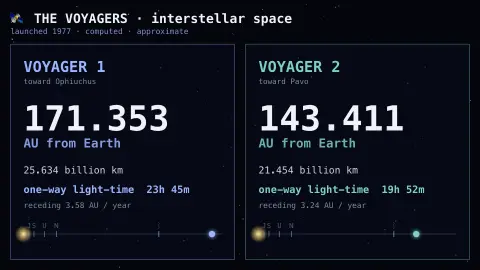
Press ESC to leave fullscreen. Settings are saved in your browser only.
How the Voyager screensaver works
The saver knows each Voyager's distance and speed and projects it forward to this exact moment, so the numbers climb in real time.
Voyager 1 is over 165 astronomical units out and Voyager 2 over 138 — each receding more than three AU every year.
It works out the one-way light-time too: how many hours a radio signal takes to reach the probe at light speed.
A small to-scale diagram shows the two craft heading out past the planets and the heliopause into interstellar space.
The Voyager missions and their long reach
Voyager 1 and Voyager 2 launched in 1977, taking advantage of a rare alignment of the outer planets that let a spacecraft use gravity assists to hop from one world to the next. Voyager 2 visited Jupiter, Saturn, Uranus and Neptune, the only spacecraft to see the last two up close, while Voyager 1 flew past Jupiter and Saturn and then headed out of the plane of the planets.
The probes crossed the heliopause, the boundary where the Sun’s solar wind gives way to the interstellar medium, in different years. Voyager 1 did so in 2012 and Voyager 2 in 2018, confirmed by sudden shifts in the plasma and particle readings. They are still within the Sun’s gravitational domain, since the Oort cloud lies much farther out; interstellar space here means beyond the solar wind, not beyond the Sun’s influence.
Distances are given in astronomical units, one of which is the average Earth-Sun gap, and as one-way light-time, how long a signal at light speed needs to cross the gap. Both probes run on radioisotope power that declines over time, so engineers have been switching off instruments one at a time to extend operations. The tallies here are projections from known trajectories, not live measurements from the spacecraft.
A worked example
The readouts tick upward — Voyager 1 at roughly 167.3 AU with a one-way light-time near 23h — the two probes, launched in 1977, still pulling farther from home every single second as they drift through interstellar space.
Settings & tips
- Accent recolours the readouts and trajectory.
- Background sets the deep-space color.
- The distances are computed locally, so it needs no connection.
Frequently asked questions
- Are the distances accurate?
- They're computed from each probe's known distance and recession rate, accurate to well within a fraction of a percent — close to NASA's live trackers.
- Does it need a connection?
- No. Everything is calculated on your device from the probes' trajectories, so it runs fully offline.
- What is one-way light-time?
- It's how long a radio signal travels from Earth to the probe at light speed — over 22 hours for Voyager 1, a sense of how far it really is.
- Are the Voyagers still working?
- Both still return data from interstellar space decades after launch, growing fainter and farther each year.
- Is it free?
- Yes — free, no download, no key, in your browser.
- Why is the light-time so long?
- Radio waves travel at the speed of light, but the probes are many billions of kilometres away. A command sent to a Voyager takes many hours to arrive, and the reply takes just as long to come back.
- Will the Voyagers ever stop transmitting?
- Their power supply declines over time, so instruments are being shut down gradually to extend the missions. Eventually there will not be enough electricity to operate the transmitters, though the probes will keep coasting through the galaxy.