Orrery Screensaver
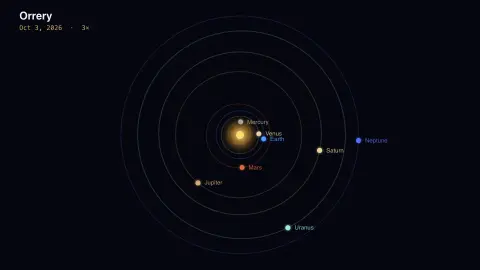
The Orrery screensaver is a live clockwork model of the solar system, showing the eight planets at their real positions for today as they orbit the Sun. It is computed on your device from current planetary elements, needs no feed, runs in your browser, and ESC exits.
Live preview
Press ESC to leave fullscreen. Settings are saved in your browser only.
How the Orrery screensaver works
The saver uses the standard Keplerian orbital elements for the eight planets and advances them to today's date with their known rates of change.
For each planet it solves Kepler's equation to find exactly where on its ellipse the planet sits right now, relative to the Sun.
The Sun is drawn at the centre with the planets as colored dots on their orbits, scaled so the inner planets aren't cramped and Neptune still fits.
A time-lapse control lets you fast-forward, watching the planets pull ahead of one another at their real relative speeds.
Why a mechanical model of the planets is called an orrery
The name goes back to the early eighteenth century, when the London instrument maker John Rowley made a clockwork model of the solar system, around 1712, for his patron Charles Boyle, 4th Earl of Orrery. Earlier mechanical devices existed, including the ancient Antikythera mechanism, dated to between 205 and 87 BC and regarded as one of the first orreries, but the earl’s name stuck to the whole genre of gear-driven models where small spheres circle a central Sun.
The positions here use Keplerian elements: a set of six numbers per orbit, namely semi-major axis, eccentricity, inclination, mean longitude, longitude of perihelion and longitude of the ascending node, each paired with a rate of change per century. NASA’s Jet Propulsion Laboratory publishes such tables for approximate planet positions, and the simpler set is valid only from 1800 AD to 2050 AD. Solving Kepler’s equation turns the elements for a date into a planet’s place on its ellipse.
The result is an approximation, not a precise ephemeris. The picture shows paths on a flat plane, and the distances between bodies are not to a single true scale, because the inner planets would be crowded against the Sun. It is a map of where things are, not of how big they are.
A worked example
The inner planets sweep quickly while Jupiter and Saturn barely creep, all at their genuine positions for today's date. Turn up the time-lapse and months fly by, the faster inner worlds lapping the slow outer giants exactly as they do in reality.
Settings & tips
- Time-lapse sets how fast the model fast-forwards through time.
- Show orbit paths draws the elliptical orbits.
- Planet labels toggles the planet names.
Frequently asked questions
- Are the planet positions real?
- Yes. They're computed from the planets' actual orbital elements for today's date, so the layout matches where the planets really are around the Sun.
- Does it need a connection?
- No. Everything is calculated locally from built-in orbital data, so it runs fully offline.
- Is the scale realistic?
- The angles and relative motion are real, but orbit radii are compressed so the inner planets and Neptune all fit on screen together.
- How is this different from Solar Systems?
- Solar Systems is an artistic generative animation; the Orrery shows the eight real planets at their true positions today.
- Is it free?
- Yes — free, no download, no key, in your browser.
- Why do the planets move at different speeds?
- Orbital period grows with distance from the Sun, as Kepler’s third law describes. Mercury circles the Sun in about a quarter of an Earth year, while Neptune takes about 164 Earth years.
- How accurate are simplified orbital elements?
- They are approximate, and only within a stated span. NASA JPL’s simpler table is valid from 1800 AD to 2050 AD and is not valid outside that interval. Professional ephemerides model gravitational interactions in far more detail.