Ocean Depth Dive Screensaver
This free screensaver is a scripted descent from the sea surface to the Challenger Deep (10,935 m, plus or minus 6 m), pausing at real landmarks such as the deepest freedive, the Titanic wreck and the deepest fish filmed. Press ESC to leave fullscreen.
Live preview
Press ESC to leave fullscreen. Settings are saved in your browser only.
How the Depth Dive screensaver works
The water colour darkens with depth through NOAA's light zones: epipelagic (0 to 200 m), mesopelagic (200 to 1,000 m), bathypelagic (1,000 to 4,000 m), abyssopelagic (4,000 to 6,000 m) and hadalpelagic (below 6,000 m, in the trenches). NOAA says sunlight does not reach below about 1,000 m, so beyond that the screen is lit only by the submersible's lamp.
The gauge shows depth in metres and feet and a pressure in atmospheres computed as 1 atm plus 1 atm for every 10 m. That is a rule of thumb, not a measurement: seawater is compressed and denser at depth, so real pressure at the bottom is a little higher (sources quote more than 1,100 atm at the Challenger Deep). The temperature line quotes NOAA's description of each zone and is not a live reading.
The descent is a scripted timeline: a smooth glide from landmark to landmark with a pause at each, so its pace is about legibility and does not represent a real dive. The vertical bar on the left is a true linear scale from 0 to 10,935 m with a tick at every landmark, so you can see how crowded the bottom is.
Marine snow (drifting particles of organic debris) streams upward as the sub sinks. The submersible, the marine snow and the silhouettes beside it are schematic, and the silhouettes are not drawn to scale.
Where the depths come from
The Challenger Deep depth, 10,935 ± 6 m, comes from Greenaway and colleagues (2021) as summarised in Wikipedia's Challenger Deep article, which also lists other estimates (10,984 m by Gardner et al. 2014 and 10,924 ± 15 m by Bongiovanni et al. 2021), the Trieste (1960), Deepsea Challenger (2012, 10,908 m) and DSV Limiting Factor (2019, 10,925 ± 4 m) dives. Light zones and typical temperatures follow NOAA (the Ocean Service light-zone page and the NOAA JetStream 'Layers of the Ocean' page).
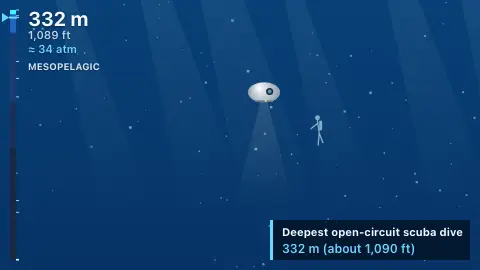
The landmark records are the deepest no-limits freedive (253 m, Herbert Nitsch, 2012, Guinness World Records), the deepest open-circuit scuba dive (332 m, Ahmed Gabr, 2014, as cited by Wikipedia's Deep diving article), the deepest recorded sperm whale dive (2,250 m, Wikipedia: Sperm whale), the deepest mammal dive (2,992 m in 137.5 minutes, Schorr et al. 2014, PLOS ONE), the Titanic wreck (3,800 m, NOAA Ocean Exploration) and the deepest fish filmed (8,336 m, Guinness World Records).
Records change. Rebreather dives are tracked separately from open-circuit dives and the freediving record on this page is the one Guinness lists; newer attempts may exist. Feet are computed from metres at 3.28084 ft per metre except where a source quotes its own conversion.
A worked example
At the Titanic wreck, NOAA gives a depth of 3,800 m (12,467 ft); the saver's rule of thumb puts the pressure there at about 1 + 380 = 381 atm. Mount Everest is 8,848.86 m tall (2020 survey), and the Challenger Deep's 10,935 m is 10,935 − 8,848.86 = 2,086 m deeper than that, about 2.1 km. A tagged Cuvier's beaked whale reached 2,992 m in a dive lasting 137.5 minutes, the deepest dive recorded for any mammal (Schorr et al. 2014).
Settings & tips
- Speed scales the whole script, including the pauses at each landmark.
- Units shows depth in metres, feet, or both.
- Deep-water colour sets the colour the water fades to below about 1,000 m; Accent recolours the gauge highlights.
- The bar on the left is a true linear depth scale; ticks mark the landmarks.
- Press ESC to leave fullscreen.
Frequently asked questions
- How deep is the Challenger Deep?
- The saver uses 10,935 m with an uncertainty of ±6 m (95% confidence), from a 2021 study based on submersible dives in 2020. Other surveys give different values, from about 10,924 m to 10,984 m, so the bottom of the Mariana Trench is known only to within tens of metres.
- Why do two sources give different depths for the same dive?
- Depth is measured with pressure sensors, sonar or both, and each has its own calibration and uncertainty. The 1960 Trieste dive is recorded as about 10,913 m in one source and 10,916 m in another; the saver shows 10,916 m and notes the other figure.
- Is the pressure reading accurate?
- It is an approximation: 1 atm plus 1 atm per 10 m. Seawater is slightly compressed at depth, so real pressure at the Challenger Deep is a little higher than the 1,095 atm the rule gives; NOAA-cited sources say more than 1,100 atm.
- Is this a real dive?
- No. It is a scripted animation with a fixed timeline. The depths and records are real; the movement, the submersible and the silhouettes are illustrative.
- What are the light zones?
- NOAA places the sunlight (euphotic) zone in the upper 200 m, the twilight zone from 200 to 1,000 m and the midnight zone from 1,000 to 4,000 m. The abyssal zone (4,000 to 6,000 m) and the hadal zone (below 6,000 m) follow the usual NOAA layers; the lower edge of the hadal zone is defined differently by some sources.
- Is the deepest fish record certain?
- The record is for the deepest fish observed in situ: a Pseudoliparis snailfish filmed at 8,336 m on 15 August 2022 in the Izu-Ogasawara Trench, species not identified. Two fish of another species were trapped at 8,022 m, the deepest fish ever captured.
- Does it need an internet connection?
- No. The depths are stored in the saver, there is no data feed, and it is free to run in the browser.