Literacy Rate Board Screensaver
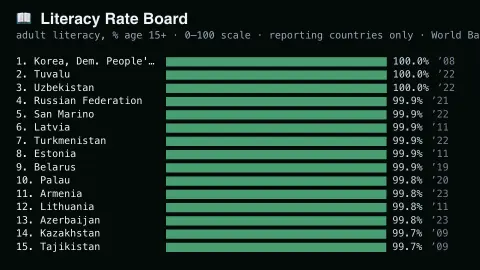
The Literacy Rate Board screensaver ranks countries by adult literacy (% of people 15 and over who can read and write), on a fixed 0–100 scale, live from the World Bank's open data API. It's free, needs an internet connection, and ESC exits.
Live preview
Press ESC to leave fullscreen. Settings are saved in your browser only.
How the Literacy Rate Board screensaver works
The saver calls the World Bank's key-less open data API for adult literacy (SE.ADT.LITR.ZS) with mrnev=1, returning each country's most recent census or survey value.
Region and income aggregates are filtered out using the World Bank's own country metadata.
Bars are pinned to a true 0–100 scale rather than stretched to the leaders, so gaps between countries read honestly.
Each row shows its own data year, because literacy surveys arrive at very different times — some values are decades old.
Adult literacy and how it gets counted
Adult literacy, as UNESCO’s Institute for Statistics defines it, is the share of people aged 15 and over who can read and write; it is typically gauged by whether a person can understand a short, simple statement about everyday life. The World Bank carries the series in its open database, with the underlying figures coming from UNESCO. Functional literacy is a separate, broader measure with several proficiency levels, and should not be confused with this basic rate.
The numbers come from national censuses and household surveys rather than from testing everyone, and for countries without recent data UNESCO has used a projection model. The criteria used to decide who counts as literate vary by country, so comparisons between countries are rough. Some high-income regions use more detailed skills assessments that are not directly comparable with this indicator.
Watch the year printed beside each row. Surveys happen on their own schedules, so the latest reading for one country may be recent while another’s dates from long ago. The board shows only countries that report a value for this series, so some countries are absent.
A worked example
Flip Rank from to lowest-first and the board becomes a map of the world's literacy challenge: South Sudan, Chad, Niger and Mali all sit below 40%. In Multi-view it pairs well with the Education Spending Board.
Settings & tips
- Countries shown — how many ranked rows to display (10–25).
- Rank from — highest literacy first (the default) or lowest first, which tells the more urgent story.
- An honest caveat: most high-income countries stopped reporting this indicator entirely, so the board is largely emerging economies — their absence is a reporting gap, not a literacy gap.
Frequently asked questions
- Is this real data?
- Yes — real census and survey literacy figures from the World Bank's open data API, each row tagged with its own data year.
- Is a key needed?
- No. The World Bank open data API is public, key-less and CORS-enabled, so the browser calls it directly.
- Does it work offline?
- No. It fetches live from the World Bank, so it needs an internet connection; offline it shows a short notice.
- Is it free?
- Yes — free, no download, in your browser.
- Why are the US, UK and most of Europe missing?
- High-income countries stopped reporting this indicator to UNESCO, so the World Bank has no recent value for them. The board honestly shows only countries that still report — mostly emerging economies.
- How is literacy different from functional literacy?
- Basic literacy is the ability to read and write a short, simple statement about everyday life. Functional literacy is a broader measure with several proficiency levels, assessed separately, and this indicator does not use it.
- Why do the data years differ between countries?
- The figures come from censuses and household surveys, which each country runs on its own schedule, so the most recent value for one country can be much older than another’s.