HighLife Screensaver
HighLife is a Conway's Game of Life sibling with the rule B36/S23 — a cell is born with exactly 3 or 6 live neighbors and survives with 2 or 3. That single extra birth condition (6 neighbors) gives HighLife something classic Life lacks: a small pattern that genuinely replicates itself across the grid.
Live preview
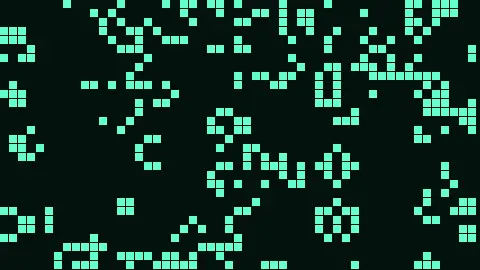
Press ESC to leave fullscreen. Settings are saved in your browser only.
How the HighLife screensaver works
Like Conway's Life, every cell is alive or dead, and the next generation is computed from each cell's eight neighbors.
HighLife's rule is B36/S23: a dead cell is born with 3 or 6 live neighbors; a live cell survives with 2 or 3.
That added "birth on 6" condition is small, but it's enough to support a real self-replicating pattern that clones a copy of itself elsewhere on the grid every so many generations.
Starting from random noise, HighLife produces its own mix of gliders, oscillators and short-lived replicator-like structures before settling or reseeding.
Nathan Thompson's single change to Life
HighLife is a variation of Conway's Game of Life devised in 1994 by Nathan Thompson. It keeps the same grid, the same eight-cell neighbourhood and the same survival rule, and changes only one thing: a dead cell with exactly six live neighbours is also born, in addition to those with three. In the usual notation that is B36/S23 instead of Life's B3/S23.
One extra number sounds trivial, but it alters what the system can do. Because the rules differ only in that extra birth condition, many simple patterns behave the same in both, and only more complex patterns diverge. HighLife's distinguishing feature is a small, simple replicator, a pattern that copies itself every 12 generations, with the copies going on to produce more.
This is why hobbyists find the rule interesting. The replicator keeps multiplying along a diagonal, and rows of replicators can be capped with blocks, eaters or blinkers to build oscillators, glider guns and spaceships. In random noise, though, you should expect the usual scatter of gliders, blinkers and still lifes rather than a clean replicator.
A worked example
Random noise collapses within a few dozen generations into scattered stable blocks and blinking oscillators, occasionally throwing off a small moving glider that drifts until it collides with something else and disrupts it.
Settings & tips
- Cell color recolours every live cell.
- Starting density sets how much of the grid begins alive.
- The board reseeds automatically once the pattern settles into stillness.
Frequently asked questions
- What makes HighLife different from Conway's Life?
- One extra birth rule — 3 or 6 neighbors instead of just 3 — which is enough to support genuine self-replicating patterns Life can't produce.
- Does a replicator always appear from random noise?
- Not reliably — true replicators need a specific starting pattern; random noise mostly produces ordinary gliders and oscillators.
- Is a key needed?
- No — it's a pure local computation.
- Is it free?
- Yes — free, no download, in your browser.
- What is a replicator?
- It is a pattern that, after some number of generations, produces copies of itself, and each copy can do the same, so the pattern multiplies across the grid. HighLife's replicator copies itself every 12 generations.
- Who created HighLife?
- Nathan Thompson first considered the rule in 1994, and it is one of the best-known variants in the family of Life-like cellular automata.
- Do Life's patterns still work in HighLife?
- Many simple ones do. The rules differ only in the extra birth-on-six condition, so differences appear mainly in more complex patterns.