Immigration Game Screensaver
The Immigration Game is a multi-color variant of Conway's Game of Life. Cells are born and die by the same classic birth/survival rules, but each new cell inherits whichever color is the majority among its three live parent neighbors — turning ordinary Life into a visible contest between spreading color factions.
Live preview
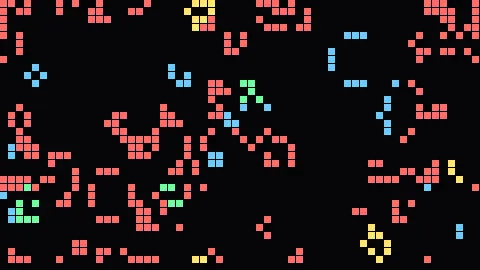
Press ESC to leave fullscreen. Settings are saved in your browser only.
How the Immigration Game screensaver works
Every live cell carries one of several real colors, not just "alive" or "dead".
Birth and survival still follow Conway's classic rule: born with exactly 3 live neighbors, survive with 2 or 3.
When a new cell is born, it takes on whichever color is the majority among its three parent neighbors — so a color that surrounds a birth site effectively wins that cell.
Over many generations this turns ordinary Life dynamics into a visible territorial contest, as colors spread, merge and get pushed back by rival colors.
Conway's Life with colour as a second dimension
The Immigration Game is a variation on John Horton Conway’s Game of Life, which was published in 1970 and first reached a wide audience in Martin Gardner’s Mathematical Games column in Scientific American that October. In plain Life, a live cell survives with two or three live neighbours and a dead cell comes alive with exactly three. Immigration keeps those rules but gives live cells a colour, which turns a one-player simulation into a contest between rival populations. Secondary sources credit Don Woods with devising it and describe it in the 1971 newsletter Lifeline.
Because the birth and survival conditions do not depend on colour, the pattern of live and dead cells is exactly what ordinary Life would produce. Colour is an added layer: a newborn cell takes the colour held by the majority of its three parent cells. Since a birth needs exactly three neighbours, a clear majority always exists.
Gliders are especially interesting here. A glider is a small pattern that travels diagonally, moving one cell every four generations, and in this game it carries its colour with it into opposing regions, where newborn cells may take a different colour. The system is deterministic, but the final colour balance is hard to predict without running it.
A worked example
Watch two colors meet along a shared front — wherever one color has more live neighbors near the boundary, new cells born there inherit that color, so the border visibly shifts in that color's favor generation by generation.
Settings & tips
- Starting density sets how much of the grid begins alive, split randomly between colors.
- Generations / sec controls the animation speed.
- The board reseeds with a fresh random mix of colors once one color dominates.
Frequently asked questions
- How is this different from ordinary Conway's Life?
- The birth and survival rules are identical — the only addition is that every new cell inherits a color from its parents, visualizing which faction is winning.
- Can one color wipe out all the others?
- Yes — a strong faction can eventually dominate the whole board, at which point the grid reseeds.
- Is a key needed?
- No — it's a pure local computation.
- Is it free?
- Yes — free, no download, in your browser.
- Is the pattern of live cells the same as in ordinary Life?
- Yes. Colour does not affect survival or birth, so the live-cell pattern is identical to standard Life from the same start.
- Who invented the Game of Life?
- John Horton Conway, a British mathematician, devised it and published it in 1970. Martin Gardner introduced it to a wide audience in Scientific American.
- Can the game be won?
- There is no scoring or end condition in this saver. Life patterns often settle into stable shapes and oscillators, and the colours stay in whatever arrangement they reached.