Physarum Network Screensaver
This screensaver runs a real agent-based Physarum polycephalum simulation — thousands of simple particles that sense and follow a trail field they themselves deposit. With no map, plan or central control, the swarm self-organizes into efficient, branching, vein-like transport networks live.
Live preview
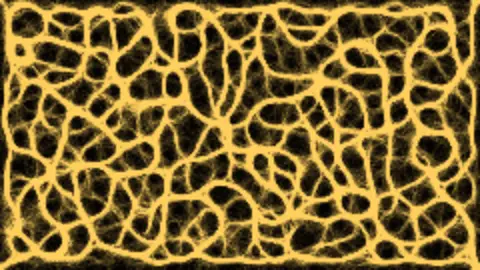
Press ESC to leave fullscreen. Settings are saved in your browser only.
How the Physarum Network screensaver works
Thousands of simple agents move across a shared trail field, each one sensing the trail strength just ahead, slightly left, and slightly right.
Each agent steers toward whichever direction has the strongest nearby trail, then deposits its own trail as it moves — real positive feedback with no central coordinator.
The shared trail field slowly fades and diffuses each frame, so only trails that are continually reinforced by many agents survive.
Over time this simple feedback loop — the same one real slime molds use to forage — self-organizes into efficient branching networks that resemble real fungal or vascular structures.
Slime mould, trail fields and transport design
Physarum polycephalum is a slime mould whose plasmodium is a single large cell with many nuclei, growing as a network of tubes with no brain or nerves. In a 2000 study it retracted from all of a maze except the shortest route between two food sources. In a 2010 experiment, oat flakes were placed at Tokyo and 36 surrounding towns, and the mould formed a network similar to the existing rail system. Those results made it a favourite model for decentralised problem solving.
The simulation here follows the kind of agent model described by Jeff Jones in a 2010 paper in the journal Artificial Life, in which large numbers of simple particle-like agents following local chemotaxis rules form transport networks on their own. Jones reported patterns such as spots, labyrinths and reticulated nets, with tension-like effects, network minimisation and repair after damage. Engineers use a related idea in ant colony optimisation, where reinforced paths stand in for pheromone.
The patterns you see depend on a few tuning values: how far ahead an agent senses, how sharply it turns, how fast trails evaporate and blur. Small changes flip the picture between dense foam, sparse veins and clumpy blobs. The picture is a model, not a recording, and a real plasmodium reacts to many things this canvas leaves out.
A worked example
Watch faint scattered trails thicken into a handful of dominant branching veins within a couple of minutes, as weaker paths fade out and agents increasingly concentrate onto the strongest routes — exactly the network-optimizing behavior real Physarum exhibits in lab mazes.
Settings & tips
- Agent count trades density of the network for performance — fewer agents settle faster.
- Trail color recolours the deposited network.
- The trail field periodically fades and reseeds so the network keeps evolving rather than freezing.
Frequently asked questions
- Is this a real simulation technique?
- Yes — it's a well-known agent-based model (sense-and-deposit trail following) used in real research to reproduce Physarum slime mold behavior.
- Does real slime mold actually build networks like this?
- Yes — real Physarum polycephalum has famously reproduced efficient real-world transit maps in lab experiments using this same sense-and-trail mechanism.
- Is a key needed?
- No — it's a pure local computation.
- Is it free?
- Yes — free, no download, in your browser.
- Who described this kind of simulation?
- The agent model is associated with Jeff Jones, whose 2010 paper in Artificial Life described how simple particle-like agents following local chemotaxis rules form Physarum-like transport networks.
- Why do the networks keep changing shape?
- Trails fade and diffuse constantly, so a route survives only while enough agents keep reinforcing it. Old veins dissolve while new ones form, so the structure never completely settles.