Chladni Plate Patterns Screensaver
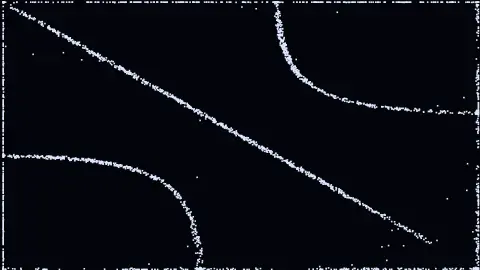
This screensaver simulates a real Chladni plate — a metal plate vibrated at a set frequency, where loose sand grains bounce away from moving regions and settle along the still nodal lines, tracing the plate's real standing-wave mode shape. The simulated frequency slowly cycles, revealing a new real nodal pattern each time.
Live preview
Press ESC to leave fullscreen. Settings are saved in your browser only.
How the Chladni Plate Patterns screensaver works
A real two-dimensional standing-wave equation models how a vibrating plate displaces at every point, for a given mode frequency.
Thousands of simulated sand grains repeatedly nudge away from points of strong vibration and settle wherever the plate's real displacement is near zero — the nodal lines.
As grains accumulate along the true nodes, the plate's genuine standing-wave mode shape emerges visually from what looks like random sand.
The simulated frequency slowly sweeps upward over time, so the pattern morphs from simple crosses and circles into increasingly intricate nodal geometry, exactly as a real Chladni plate does.
Ernst Chladni and the sound figures on a plate
In 1787 the German physicist Ernst Chladni published his method of drawing a bow across the edge of a metal plate lightly covered with sand. The sand gathered along still lines in sharp patterns, now called Chladni figures, which made the shape of a vibration visible. In 1808 he demonstrated them to the Paris Academy with Napoleon in the audience, and Napoleon then set a prize for the best mathematical explanation of vibrating plates.
The patterns mark where the plate does not move. A plate vibrates in distinct modes, each with its own frequency, and every mode has nodal lines where displacement stays at zero while neighbouring regions swing up and down. Sand thrown off the moving areas ends up on the quiet lines, and higher frequencies generally give more nodal lines and finer figures.
Explaining the patterns mathematically took years. Sophie Germain entered the Academy’s contest several times and won in 1816 under her own name, although her plate equation relied on an incorrect assumption and was later superseded by the Kirchhoff–Love theory. Variations of Chladni’s technique are still used today in designing and building instruments such as violins, guitars and cellos.
A worked example
At a low simulated frequency, sand settles into a simple cross or a single circle. As the frequency climbs, watch the nodal lines multiply into a genuinely intricate lattice — the same real transition physics demonstrations show on an actual vibrating steel plate.
Settings & tips
- Sand color recolours the settling grains against the dark plate.
- The frequency sweeps automatically — no input needed to see new patterns.
- Grains reset and resettle each time the frequency shifts far enough.
Frequently asked questions
- Is this based on a real physical phenomenon?
- Yes — Chladni plates are a real 18th-century acoustics demonstration; this simulates the same standing-wave math that produces their real nodal patterns.
- Why do the grains move at all if the plate is just vibrating in place?
- Regions of strong vibration physically bounce loose grains away, while motionless nodal lines don't — so grains naturally accumulate only where the plate is still.
- Is a key needed?
- No — it's a pure local computation.
- Is it free?
- Yes — free, no download, in your browser.
- Why does sand collect on lines rather than spread out?
- Sand is bounced around wherever the plate surface moves and stays put wherever it is still. After enough bounces nearly every grain has landed on a node, the places with no motion.
- Who won the prize for explaining the patterns?
- The French mathematician Sophie Germain won the Paris Academy’s prize in 1816, on her third attempt, for her theory of elastic plates. The Academy was not fully satisfied with it, and her equation was a special case of the later, more accurate Kirchhoff–Love theory.