Forest Fire Automaton Screensaver
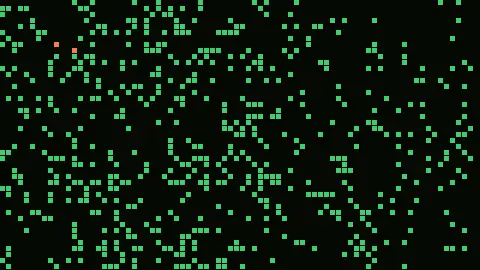
This screensaver runs the real classic forest-fire cellular automaton — empty ground has a small chance to sprout a tree each tick, a rare lightning strike ignites a random tree, fire spreads instantly to every burning tree's neighbors, and burnt ground clears back to empty, ready to regrow, in an endless real cycle.
Live preview
Press ESC to leave fullscreen. Settings are saved in your browser only.
How the Forest Fire Automaton screensaver works
Every cell is empty ground, a tree, or actively burning, updated by three real simple probabilistic rules each tick.
Empty ground has a small real chance to sprout a new tree each tick — slow, steady regrowth.
A tree has a tiny real chance of a lightning strike igniting it directly, and any tree next to a burning cell catches fire on the very next tick.
A burning cell always turns to empty ground the following tick, clearing the way for real regrowth — producing the same real boom-and-bust density cycle seen in ecological forest-fire models.
Self-organised criticality in the forest-fire model
The forest-fire model is a minimal grid system in which cells are empty, tree or burning. Per Bak, Kan Chen and Chao Tang published an early version in 1990, framed partly as a toy model of turbulence, and it was introduced as a supposedly self-organised critical model. Later work found that it is not critical in two dimensions. Barbara Drossel and Franz Schwabl’s 1992 version added a small probability of lightning igniting a tree, and it is the one most often simulated.
The behaviour depends on the regrowth probability p, the lightning probability f, and above all their ratio p/f, the average number of trees planted between two lightning strikes. When lightning is rare compared with regrowth, forests grow dense before a spark hits, and the resulting fires are large. When strikes are common, fires are small and frequent, and the forest stays patchy. Drossel and Schwabl reported a self-organised critical state as f approaches zero, provided tree growth and the burning of whole clusters happen on separate time scales.
As an ecology model it is deliberately crude: there is no wind, terrain, species or moisture, and fire passes instantly between neighbouring cells. Its value is as a toy for exploring how sparse random events and slow recovery can produce clumped patterns, and its scaling behaviour is subtle enough that physicists have kept studying it.
A worked example
Watch a dense forest region get struck by lightning and the fire race outward through packed trees in a visible burning front within a few ticks, leaving bare ground behind that only slowly, patiently regrows over the following minute.
Settings & tips
- Tree color recolours the growing forest.
- Fire color recolours the actively burning cells.
- Regrowth and lightning rates are tuned so the forest never fully burns out or fully fills in.
Frequently asked questions
- Is this a real ecological model?
- Yes — the forest-fire cellular automaton is a well-known real model used to study self-organized criticality in real ecological and physical systems.
- Why doesn't the whole forest burn down and stay empty?
- Because regrowth is continuous — empty ground keeps sprouting new trees at a steady real rate even while other regions are burning.
- Is a key needed?
- No — it's a pure local computation.
- Is it free?
- Yes — free, no download, in your browser.
- What is self-organised criticality?
- It describes systems that evolve on their own toward a critical state in which disturbances of many sizes occur, with no outside tuning of a parameter. The sandpile model is the classic example.
- Why do the fires look fractal?
- Fire only spreads through connected clumps of trees. In the regime where lightning is very rare and regrowth is slow relative to burning, the sizes of burned clusters follow scaling laws that Drossel and Schwabl described as critical.
- How does the lightning rate change the look?
- Rare lightning lets large dense forests build up and burn together, while frequent lightning keeps the forest sparse with many small fires.