Phyllotaxis Spiral Growth Screensaver
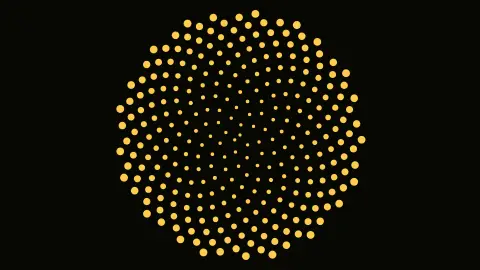
Phyllotaxis is the real botanical pattern behind sunflower heads, pinecones and pineapples — each new seed is placed at exactly the golden angle, about 137.5°, further round than the last, at a distance from center that grows with the square root of the seed's index. This screensaver grows that exact real pattern outward, one seed at a time.
Live preview
Press ESC to leave fullscreen. Settings are saved in your browser only.
How the Phyllotaxis Spiral Growth screensaver works
Every new point is placed at an angle exactly 137.5° — the golden angle, derived from the golden ratio — further around than the previous point.
Each point's distance from the center grows in proportion to the square root of how many points have been placed so far, which is what keeps the seeds evenly packed rather than bunching up.
Because 137.5° is an irrational fraction of a full circle, no two seeds ever line up exactly, which is exactly what prevents wasted gaps in the real packing.
The combination of these two real simple rules is what produces the interlocking spiral arm families visible in real sunflower heads and pinecones.
Fibonacci spirals in seed heads
Phyllotaxis, from the Greek for leaf arrangement, is the study of how leaves, petals and seeds are positioned around a stem. In many plants the spirals visible in a sunflower head or pine cone come in two interlocking families, and the counts in each are usually neighbouring Fibonacci numbers. In 1868 Wilhelm Hofmeister proposed that new leaves form in the least crowded part of the shoot tip, and the golden angle emerges from that packing.
The model drawn here is usually credited to Helmut Vogel, whose 1979 paper in Mathematical Biosciences, 'A Better Way to Construct the Sunflower Head', places floret number n at radius proportional to the square root of n, turning each by a fixed divergence angle. The golden angle, about 137.5 degrees, is 360 degrees divided by phi squared. The square root keeps density uniform, and the pattern is very sensitive to the angle: a change of even one degree breaks it up.
Why would plants do this? Douady and Couder (Physical Review Letters, 1992) showed that phyllotactic patterns can arise as a self-organising growth process. In their experiment magnetised drops of ferrofluid fell into oil and repelled one another, and the resulting angle depended on how fast the drops were released. Vogel's model is purely geometric and does not itself explain the biology.
A worked example
Watch the count climb past a hundred seeds and multiple spiral arm families become visible at once — commonly 21, 34 or 55 arms, real neighboring Fibonacci numbers, exactly as counted on real sunflower heads.
Settings & tips
- Seed color recolours every placed point.
- The pattern regrows from the center once it fills the visible area.
- Try counting the visible spiral arms in both directions — they're almost always consecutive real Fibonacci numbers.
Frequently asked questions
- Is this the actual pattern real sunflowers use?
- Yes — the golden-angle placement rule is a well-documented real botanical model matching real seed-head packing in sunflowers, pinecones and more.
- Why the golden angle specifically?
- Its irrationality means no seed ever lines up radially with an earlier one, which real research shows minimizes wasted gaps as the head grows.
- Is a key needed?
- No — it's a pure local computation.
- Is it free?
- Yes — free, no download, in your browser.
- Why do sunflowers show Fibonacci numbers?
- The golden angle packs seeds so that the visible spirals come in counts that are neighbouring Fibonacci numbers. The numbers are a consequence of the angle, not a rule that plants follow on purpose.
- What happens if the angle is slightly different?
- Even a small change, around one degree, breaks the pattern, leaving gaps instead of filling the disc evenly. That is why the golden angle works so well in this model.