Superformula Shape Morphing Screensaver
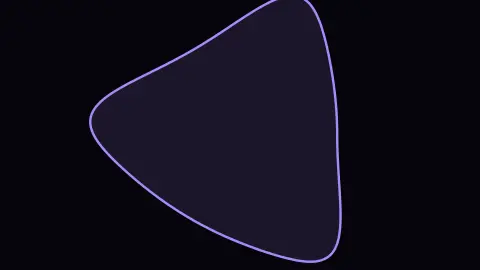
The superformula is a real single polar equation, published by Johan Gielis in 2003, that generalizes circles, polygons, stars and countless organic shapes from just a handful of parameters. This screensaver slowly drifts those real parameters over time, continuously morphing the outline between flowers, gears, stars and blob-like forms.
Live preview
Press ESC to leave fullscreen. Settings are saved in your browser only.
How the Superformula Shape Morphing screensaver works
For every angle around a circle, the real superformula computes a radius from six parameters — a symmetry count and five shape exponents.
Small changes to those parameters produce dramatically different real outlines: circles and ellipses, n-pointed stars, gear-like polygons, and smooth organic blobs are all genuinely the same formula.
This screensaver slowly and continuously drifts the parameters over time using gentle sine waves, so the outline is always genuinely mid-transition between recognizable shape families.
The same real formula, discovered by botanist Johan Gielis, was originally created to describe shapes found throughout nature — from starfish to diatoms to flower petals.
Gielis's superformula and generalised shapes
Johan Gielis, a Belgian scientist, proposed the superformula in a 2003 paper, “A generic geometric transformation that unifies a wide range of natural and abstract shapes”, in the American Journal of Botany (volume 90, pages 333–338). It generalises the superellipse, a shape named and popularised by the Danish mathematician Piet Hein, into a single polar formula that gives the radius as a function of angle.
The formula is r(φ) = (|cos(mφ/4)/a|^n2 + |sin(mφ/4)/b|^n3)^(−1/n1). The parameter m sets the rotational symmetry, so m = 4 gives four lobes and m = 5 five. The exponents n1, n2 and n3 control how pinched or bulging the lobes are, and a and b scale the shape along its axes. Moving smoothly through values makes the outline change continuously, which is why animations of the formula look like shapes growing petals or turning into stars.
Gielis suggested that the formula can describe many complex shapes and curves found in nature. It is best treated as a flexible curve-fitting tool: a good fit to a flower or shell outline does not prove that nature uses the equation.
A worked example
Watch a 5-pointed star gradually round its points into a smooth flower shape, then keep drifting into an asymmetric organic blob — all from the exact same underlying real equation, just with its parameters slowly sliding.
Settings & tips
- Shape color recolours the drawn outline.
- The shape's symmetry count changes periodically for variety.
- Watch a full morph cycle — it typically takes under a minute to cross several distinct shape families.
Frequently asked questions
- Is this a real mathematical/botanical formula?
- Yes — the superformula was published by botanist Johan Gielis in 2003 and genuinely describes a wide range of natural and geometric shapes with one equation.
- Is a key needed?
- No — it's a pure local computation.
- Is it free?
- Yes — free, no download, in your browser.
- What real shapes can the formula produce?
- Circles, ellipses, regular polygons, n-pointed stars, gear shapes and many organic, flower-like or starfish-like outlines, all from one formula.
- What do the symmetry parameter and exponents do?
- The symmetry parameter m sets the number of lobes or corners, while the exponents control how sharp or rounded they are and whether they bulge outward or pinch inward.
- Is the superformula the same as a superellipse?
- No, it generalises it. The superformula adds a rotational symmetry parameter and separate exponents, so it covers stars and flowers as well as rounded rectangles.
- Who came up with it?
- Johan Gielis proposed it in 2003 in the American Journal of Botany, as a way to describe a wide range of natural and abstract shapes with a few parameters.