Day & Night Screensaver
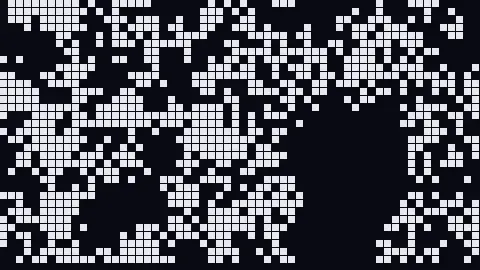
Day & Night is a Conway's Life variant with the rule B3678/S34678, built so that swapping every live cell for dead and dead for live produces exactly the same rule. Starting from near-even density, light "day" regions and dark "night" regions evolve as genuine mirror-image twins.
Live preview
Press ESC to leave fullscreen. Settings are saved in your browser only.
How the Day & Night screensaver works
Every cell is alive ("day") or dead ("night"), updated each generation from its eight neighbors, just like Conway's Life.
The rule is B3678/S34678 — a dead cell is born with 3, 6, 7 or 8 live neighbors; a live cell survives with 3, 4, 6, 7 or 8.
This rule set is symmetric under inversion: flip every cell's state and the rule produces the identical next generation, just inverted.
Starting near 50% density lets you watch light and dark regions grow, ripple and collide as real structural mirror images of each other.
Life-like rules and inversion symmetry
Conway's Game of Life belongs to a large family of two-state cellular automata that use the same eight-cell neighbourhood but differ in the counts needed for birth and survival. A shorthand called Life-like notation, B/S, lists them: Life itself is B3/S23. Day & Night is the rule B3678/S34678. It was invented and named in 1997 by Nathan Thompson and studied in detail by David I. Bell, who constructed many of its known patterns.
What sets it apart is a symmetry. Inverting every cell produces a future that is the inversion of the original's future, so every pattern has an antipattern and every localised object has an antiobject that behaves the same against an inverted background. In Life an empty plane stays empty; here a live-dominated region and a dead-dominated region are exact mirror images.
From random starts with each cell live at probability one half, large "day" and "night" regions form and gradually coarsen and merge. Their boundaries stay active, with small patterns constantly created and destroyed, while interiors tend to settle into small still lifes and oscillators. Known spaceships include the period-40 Rocket, the diagonal Butterfly (period 3, speed c/3) and the orthogonal Snail (period 14, speed c/7).
A worked example
Look for a light blob and a dark blob of similar shape drifting near each other — swap your eye's focus from live to dead cells and the pattern looks the same, because the rule genuinely treats both states identically.
Settings & tips
- Cell color recolours the live "day" cells against the dark background.
- Starting density is set near 45% by default so both day and night regions form clearly.
- The board reseeds once the pattern settles into stillness.
Frequently asked questions
- What does "symmetric" mean here?
- Inverting every cell — live becomes dead and dead becomes live — produces an identical rule, so light and dark patterns behave as true structural mirrors.
- Is a key needed?
- No — it's a pure local computation.
- Is it free?
- Yes — free, no download, in your browser.
- Is this related to Conway's Game of Life?
- Yes — it uses the same neighbor-counting mechanics, just with a different, symmetric birth/survival rule.
- What does B3678/S34678 mean?
- B lists the neighbour counts that make a dead cell become alive (3, 6, 7 or 8) and S lists those that let a live cell survive (3, 4, 6, 7 or 8).
- Are there spaceships in Day & Night?
- Yes. Known ones include the Rocket (period 40), the Butterfly and the Snail, and the symmetry means each has an inverted counterpart that behaves the same way.
- Who invented Day & Night?
- The rule was invented and named in 1997 by Nathan Thompson, and David I. Bell later studied it in detail and built many of the known patterns.